
.jpg)
At Coherent Solutions’ Training Center, trainers spent hours going over the same code submissions and giving the same feedback but still couldn’t keep up. Assignments stacked up, feedback took longer, and trainees sometimes waited days to find out what needed fixing. The problem was about capacity, not quality.
As companies put more resources into AI tools and workflows, training turns into a key requirement instead of just a support role. Being able to create curriculum, run sessions, and give quick feedback is what lets employees use new skills. But in reality, this often leads to a bottleneck. There aren’t enough qualified reviewers to keep up, and without fast, clear feedback, people can’t put what they learn into practice.
By summer 2024, the team realized they needed to make a change. Rather than seeing grading as something they just had to accept, the Training Center came up with a new approach. Now, code submissions are checked by an automated system that uses a set rubric. The system reviews the work, checks the requirements, and sends out structured feedback several times a day.
The system now takes care of 80% to 90% of assignment reviews at the Training Center, and feedback that once took days now arrives in just a few hours.
This shift reflects a broader pattern in AI adoption. According to Forrester, “by understanding where current bottlenecks exist, these new AI capabilities can be directed to deliver the best possible outcomes for specific roles.”
The first big win was faster feedback, but the real advantage showed up once the team understood what that time savings meant in practice.
From workflow fix to capability engine
Automating grading fixed the main problem right away, but the bigger benefits showed up later. With less time spent on repetitive reviews, trainers could spend more time developing courses, improving the curriculum, and testing new AI tools.
This led to several benefits and changed what the team was able to accomplish.
In the following months, the Training Center turned its AI curriculum into a structured AI training framework. The goal was straightforward: help employees go from basic awareness to practical use, and then to advanced skills.
The framework now includes four levels:
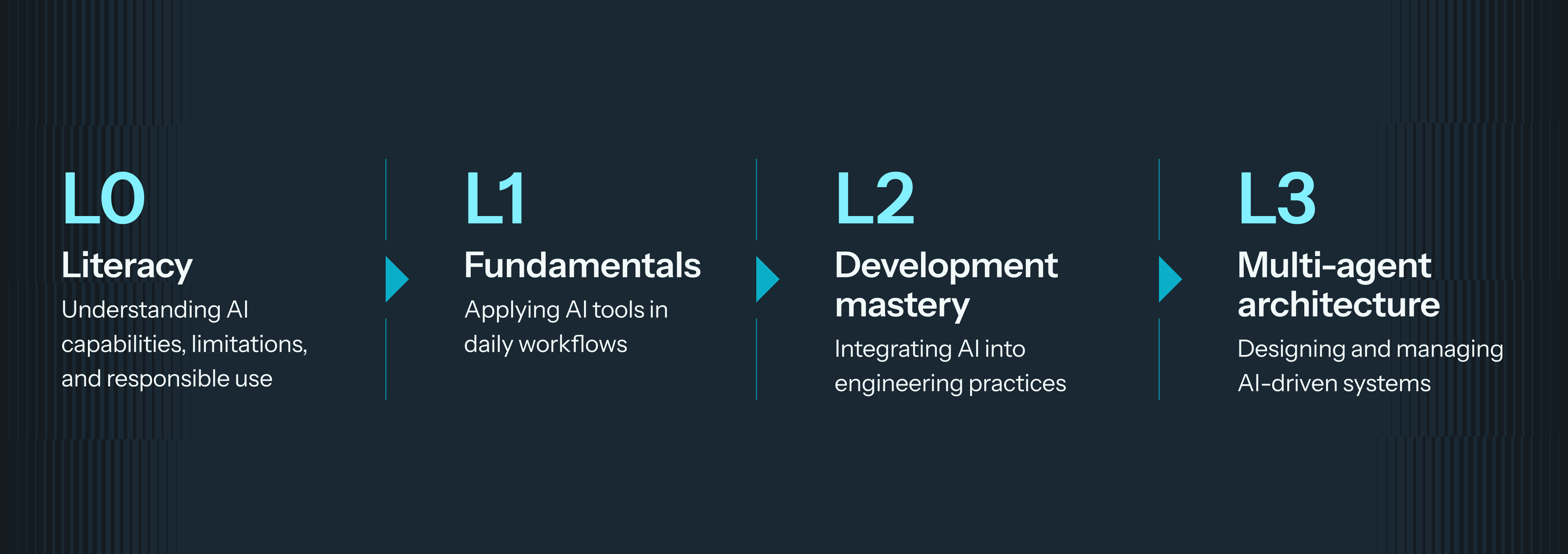
This progress did not happen overnight. The team built the framework step by step, tested it regularly, and updated it as the field evolved.
As of early 2026, 756 employees have participated in AI training, with 1,116 total enrollments across courses. This represents over a third of the company’s workforce.
Not only that, but a change in behavior is clearly visible. At the start of 2025, less than half of participants used AI regularly at work. By that fall, everyone in the courses reported using AI. The focus shifted from whether to use AI to how to use it more effectively.
This kind of shift does not happen through access to tools alone. It requires structured enablement. As Forrester notes, “leaders must invest in upskilling employees through tailored training programs… empowering employees to embrace AI is key to unlocking its full value.”
The priority is shifting in 2026 toward developer upskilling and production use of AI tools. Courses like Claude Code Mastery have quickly become some of the most in-demand, signaling a move from awareness to hands-on engineering workflows.
This is clearly visible in the data. Around a quarter of participants move from foundational training to developer-level courses, and a smaller group continues into advanced AI engineering.
This type of growth wouldn’t be possible if the trainers were still reviewing every submission by hand. Automation accelerated the feedback process and enabled the Training Center to expand its AI curriculum.
Removing the blank page
However, grading was just one of several challenges inside the Training Center.
Knowledge sharing was another big challenge. Each practice area was expected to provide updates, resources, and recommendations for EduDigest, which offers curated summaries of trends, tools, books, and learning materials for each field. In practice, participation was inconsistent. Teams were busy and often prioritized deadlines. Sometimes, especially in the summer, there were fewer submissions.
When experts did not contribute regularly, creating each digest required manual research, checking links, drafting content, and formatting. This process was time-consuming and became harder to manage as the company grew.
Instead of lowering standards or publishing less often, the Training Center decided to redesign the process.
They developed a multi-step AI system to create structured draft digests. Different agents scanned for trends, found books, checked links, and put everything together into a draft for each practice area. The drafts were not final. They served as starting points.
Now, the system can create draft versions for nine practice areas in about fifteen minutes. Previously, this amount of research and drafting would have required much more manual effort.
The biggest change was not just automation. It was removing the blank page. Instead of asking experts to start from scratch, the Training Center now provides a draft for them to review and improve. AI handles the first round of gathering, and people add their expertise.
The same idea that changed grading worked here too. Take away the repetitive tasks and keep the important thinking.
By this point, AI was no longer just a topic in courses. It had become part of the Training Center’s daily routine through operational AI automation.

What this pattern reveals about AI adoption
At first glance, automated grading and EduDigest drafts might look like small workflow tweaks. In reality, they represent something much more significant.
In both examples, AI helped clear away obstacles. For grading, it took care of repetitive reviews. For EduDigest, it managed research and drafting. These systems did not replace expert knowledge; they saved time on routine tasks.
These types of changes impact what a small team can take on. When there are fewer repetitive tasks, teams can spend more time on design, improvement, and growth. Over time, this shift helps programs move forward instead of staying the same.
Speed is another important factor. The basic AI course is updated every month, with about five to ten percent of the content changing each time. Since January 2025, about half of the material has been revised or replaced. As the field changes quickly, the curriculum stays current.
This combination of automation, regular updates, and active involvement creates a positive cycle. AI tools make work easier, giving people more time to teach and try new things. Teaching improves understanding and better understanding leads to an increase in daily usage.
Over time, AI shifts from being a special project to becoming a normal part of daily work.
At the Training Center, this shift started with a simple choice. Automate the most repetitive tasks and use the time saved to work on bigger projects, which helped drive internal AI adoption.
How experimentation became everyday practice
The Training Center didn’t scale AI adoption through a top-down initiative. AI was introduced where it removed constraints such as grading, content creation, and internal workflows. This then created the capacity to expand training and evolve the curriculum.
Over time, this approach proved repeatable. Start with real workflow constraints, apply AI where it removes friction, and build structured pathways that help people move from usage to capability.
What began as a workflow fix inside the Training Center created the capacity to build AI capability across the organization.
SHARE ARTICLE



.jpg)