Custom platforms built around your workflows
What differentiates biotech, lab & diagnostic providers, CROs, and care operators is how well their workflow and experience layers perform for users who rely on them. We design and engineer that layer.


Where the system of record ends and the workflow begins
Lab technicians, regulatory reviewers, researchers, care managers, and patients spend their day in the gap between what the system of record stores and what the work requires. We design the applications, mobile experiences, and AI-assisted workflows that close that gap, on top of the core or in place of it.
 Specialized workflows outgrow the system of record
Sample handling, study milestones, protocol deviations, and reference-range checks run alongside the core system rather than inside it. Our teams design life science workflow layers with the traceability quality and compliance leaders require.
 Regulatory work happens outside the regulatory platform
Legacy forms, paper approvals, and emailed submissions mean no single working copy and no reliable record of who approved what. We create submission and approval platforms where every contributor works on one version and every change is attributable.
 Decades of rules sit in systems no one can safely change
Search, matching, and outcomes reporting carry accumulated logic that only a few people understand. Our engineers document, test, and reimplement it on maintainable platforms with ranking that’s auditable and data layers that reporting teams can trust.

 Batch records are still on paper or PDF
Manufacturing execution systems define the process but leave the operator experience to paper and memory. Our teams design mobile floor applications that guide each step, capture data at the source, and produce the record review needs.
 Quality events are managed in email and spreadsheets
The QMS exists, yet investigators still chase signatures and assemble evidence by hand. We build quality event applications that route approvals, surface related history, and shorten the path from detection to closure.
 Process data is collected but not used
Cell and gene therapy, biologics, and specialty processing require verified identity and custody at every handoff, often confirmed by hand. We design tracking and verification workflows with scan-based checkpoints and equipment integration.

 Care teams coordinate through suboptimal experiences
Outreach lists, care plans, and interventions live in spreadsheets because the care management platform doesn’t match how the team works. We design care team dashboards and mobile workflow tools that put tasks, risk scores, and next actions in one view.
 Operational workflows aren’t in the core system
Intake, provider availability, patient-provider matching, and credentialing live in point tools and spreadsheets because the EHR handles them poorly. We rebuild those workflows as configurable modules with intelligent scheduling, matching engines, and mobile intake that you can control.
 The EHR has become a constraint on growth
A new line of business or patient offering stalls because the packaged EHR can’t support it. We define and architect replacement modules and integrated platforms, and sequence the rebuild to ensure the patient experience remains uninterrupted.

 The patient portal is a login, not a care experience
EHR systems hold the record, yet patients still schedule appointments by phone, receive instructions on paper, and call for status updates. We design mobile care journey apps and patient portals that turn the record into guided next steps.
 Outcome data arrives late, on paper, and incomplete
Risk assessments and outcome measures sit on forms that someone keys in later. Our teams create digital capture workflows with adaptive questioning and flagged risk signals that feed directly into clinical dashboards and research datasets.
 The first and last mile of care are manual
Registration forms are filled out on paper, risk screenings happen in the waiting room, and follow-up depends on a staff member remembering to call. We build digital intake, risk assessment, and communication workflows that reach patients on their phones before and after the visit.

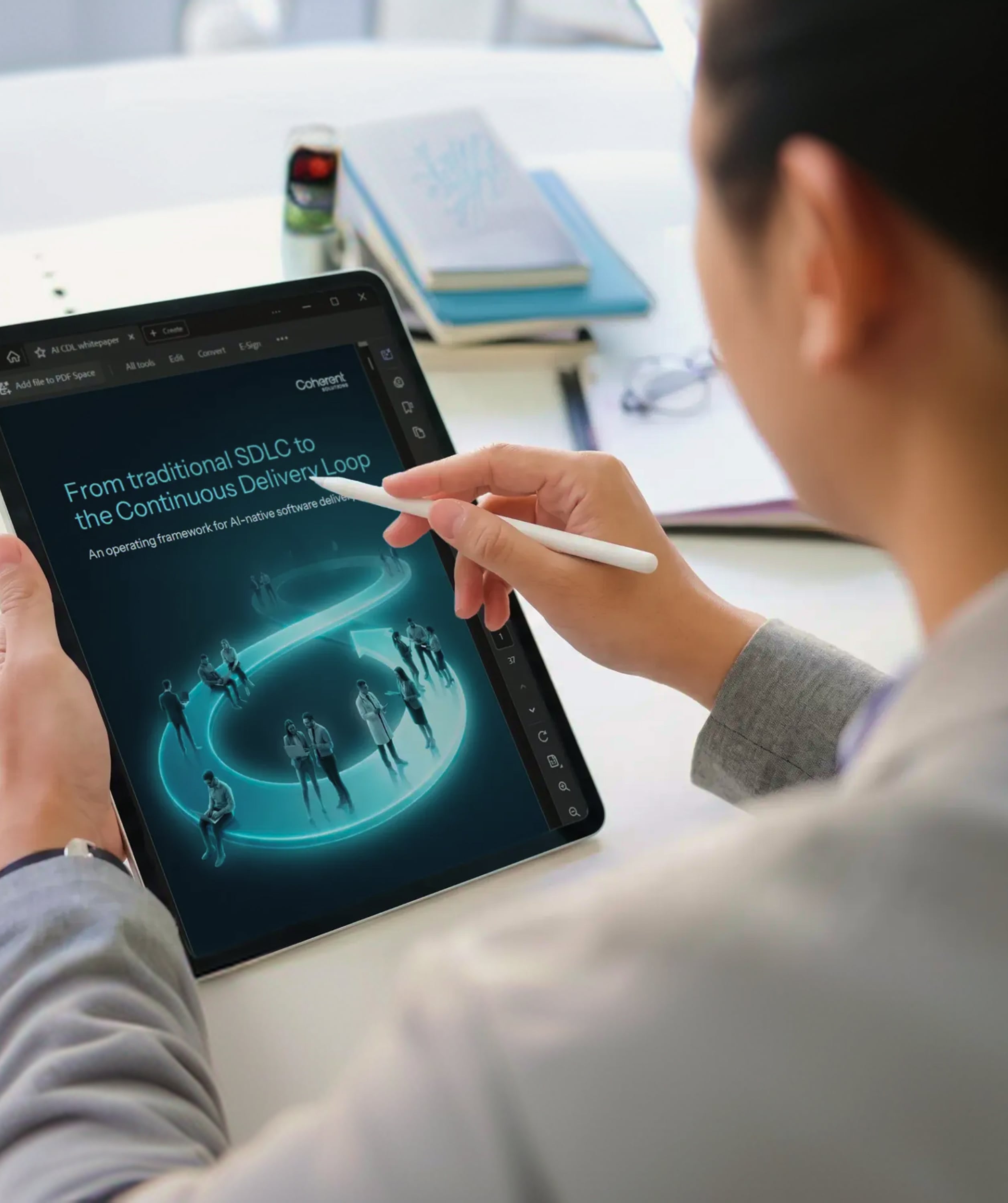
From traditional SDLC to the Continuous Delivery Loop
 Download now
We’ve worked inside the lab, the clinic, and the registry
Our teams have extended LIMS with bench modules, rebuilt donor-matching systems, created regulatory collaboration platforms, designed mobile patient experiences integrated with EHRs, and built quality software compliant with GMP.
We are not learning the life sciences & healthcare industry from a requirements document.
We know the difference between a feature that works and one that’s validated; we build for the second.
We’ve designed for the technician with gloves on, the patient between appointments, and the operator mid-batch.
Diagnostics labs, transplant networks, regulatory teams, care providers, and biomanufacturers trust us with the systems their work depends on.

"Coherent Solutions brings experienced, top-level engineers who have been instrumental in our API testing and automation efforts. Their proactive approach, technical expertise, and commitment to deadlines have strengthened our project and ensured high-quality software delivery."
Lara I., Software Quality Team Lead, Cellares
 Connect with our experts
Case Studies


More Case Studies
, hide_author_name_=false, module_id=224238135902, select_blog=224579243279, select_tag=healthtech-life-sciences}, child_css={}, css={}, id=module_179015393630755, label=Related Case Study Posts, module_id=224238135902, name=module_179015393630755, order=12, styles={}, type=module}, module_179120410606221={body={counter=[], logo_image={src=}, module_id=223627951216}, child_css={}, css={}, id=module_179120410606221, label=Case Study Posts Title, module_id=223627951216, name=module_179120410606221, order=2, styles={}, type=module}, module_179121160763349={body={module_id=223636303144, slider_image=[]}, child_css={}, css={}, id=module_179121160763349, label=fullwidth-image-slider, module_id=223636303144, name=module_179121160763349, order=8, styles={}, type=module}, module_179121390029660={body={discription=Business Challenge
Despite our client boasting a high level of automation and efficiency in the processes, certain aspects still needed periodic manual intervention to ensure the highest standards of service. Like any advanced hi-tech company, the client wanted to reduce manual data processing to a minimum.
The client turned to Coherent Solutions to design a cutting-edge Robotic Process Automation (RPA) solution from the ground up. The solution’s core aim was to streamline previously manual processes, increasing operational efficiency and reducing costs.

Solution
Our team of two dedicated RPA engineers was tasked with developing an RPA solution focusing on optimizing internal processes, reducing human errors, and achieving cost-efficiency. When undertaking RPA projects, we first think about the following pain points:
-
Which activities and processes our client wants to automate first?
-
What are short-term and long-term automation goals?
-
How will the RPA solution affect the client’s stakeholders?
-
What additional IT infrastructure and resources will be needed to support the smooth solution operation?
After the thorough examination of the points above, our team chose the iterative refinement of the RPA implementation. The project took 9 months to complete. To achieve precision in automation, we integrated UiPath infrastructure from the ground up. This strategic approach ensured a robust and scalable foundation. Upon completion, we delivered a solution tailored to the unique requirements of our client. The product met the client’s requirements in terms of optimizing internal processes, reducing human errors, and achieving cost-efficiency.

Results
By designing the RPA solution, we helped our client achieve tangible results, including:
-
Enhanced Operational Efficiency: We managed to achieve improved overall efficiency by automating repetitive and time-consuming tasks. Such a high level of automation of cloud-based, desktop-based, and browser-based systems led to an impressive 85% decrease in processing time, significantly speeding up internal operations.
-
Higher Level of Accuracy: The automation of critical processes resulted in reduced human errors and advanced accuracy.
-
Streamlined Workflows: As we integrated a variety of applications, including Monday.com, SFTP, AWS, Google Workspaces, and Slack, it helped enhance communication and collaboration and optimized workflows.
-
Boosted Cost Efficiency: The implementation of automation led to substantial cost savings, with operational costs decreasing by 92%. This reduction reflects the significant financial benefits derived from the streamlined and automated infrastructure.
Business Challenge
Despite our client boasting a high level of automation and efficiency in the processes, certain aspects still needed periodic manual intervention to ensure the highest standards of service. Like any advanced hi-tech company, the client wanted to reduce manual data processing to a minimum.
The client turned to Coherent Solutions to design a cutting-edge Robotic Process Automation (RPA) solution from the ground up. The solution’s core aim was to streamline previously manual processes, increasing operational efficiency and reducing costs.
Solution
Our team of two dedicated RPA engineers was tasked with developing an RPA solution focusing on optimizing internal processes, reducing human errors, and achieving cost-efficiency. When undertaking RPA projects, we first think about the following pain points:
-
Which activities and processes our client wants to automate first?
-
What are short-term and long-term automation goals?
-
How will the RPA solution affect the client’s stakeholders?
-
What additional IT infrastructure and resources will be needed to support the smooth solution operation?
After the thorough examination of the points above, our team chose the iterative refinement of the RPA implementation. The project took 9 months to complete. To achieve precision in automation, we integrated UiPath infrastructure from the ground up. This strategic approach ensured a robust and scalable foundation. Upon completion, we delivered a solution tailored to the unique requirements of our client. The product met the client’s requirements in terms of optimizing internal processes, reducing human errors, and achieving cost-efficiency.
Results
By designing the RPA solution, we helped our client achieve tangible results, including:
-
Enhanced Operational Efficiency: We managed to achieve improved overall efficiency by automating repetitive and time-consuming tasks. Such a high level of automation of cloud-based, desktop-based, and browser-based systems led to an impressive 85% decrease in processing time, significantly speeding up internal operations.
-
Higher Level of Accuracy: The automation of critical processes resulted in reduced human errors and advanced accuracy.
-
Streamlined Workflows: As we integrated a variety of applications, including Monday.com, SFTP, AWS, Google Workspaces, and Slack, it helped enhance communication and collaboration and optimized workflows.
-
Boosted Cost Efficiency: The implementation of automation led to substantial cost savings, with operational costs decreasing by 92%. This reduction reflects the significant financial benefits derived from the streamlined and automated infrastructure.



Ready to build something people use every day?
Whether you want to launch a new product, scale an existing platform, or recover legacy technical debt, let’s talk about what’s actually blocking you.