
AI has significantly changed how software is built. What hasn’t changed, however, is how most organizations deliver that software.
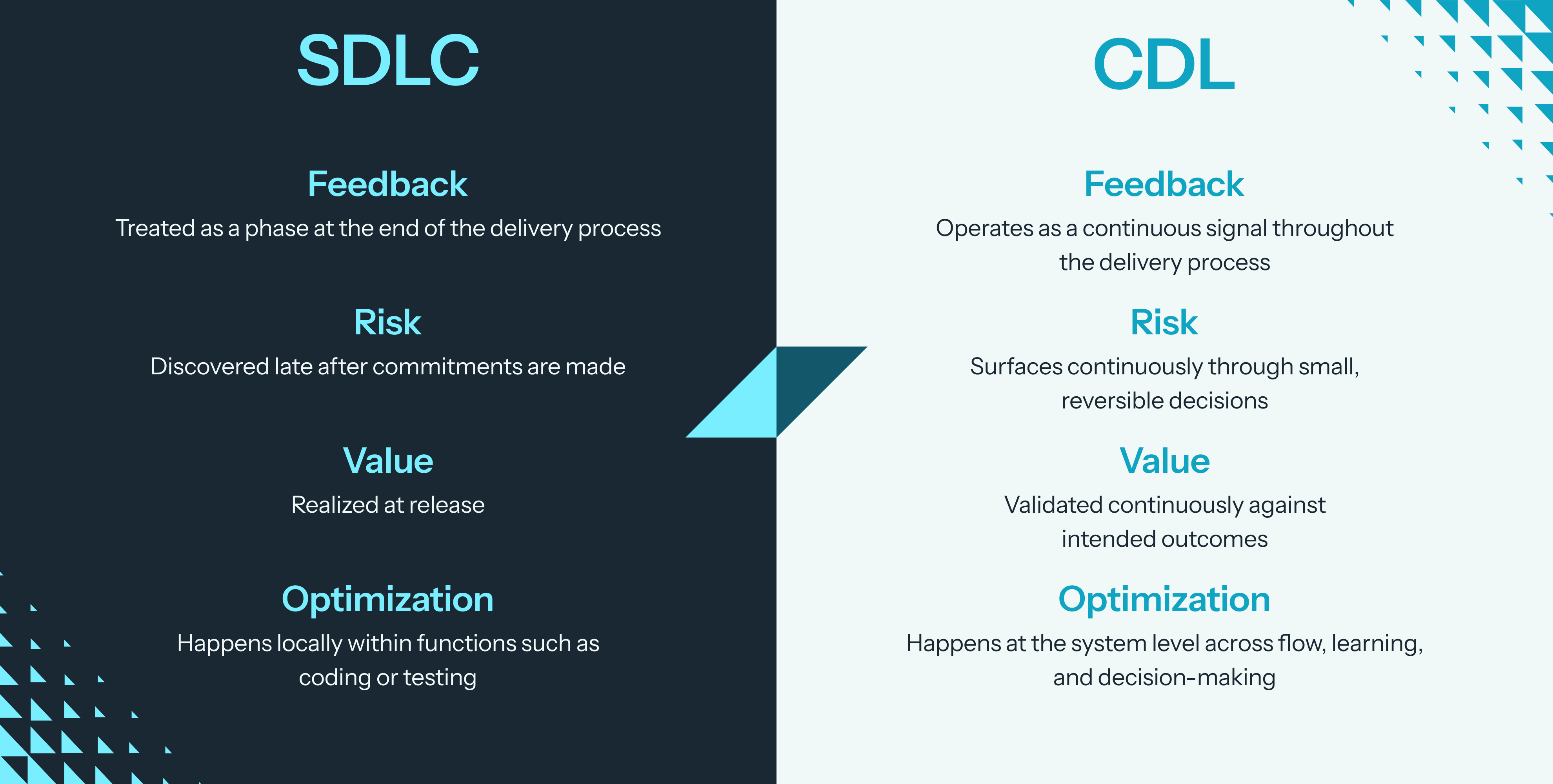
Many teams use AI copilots, automated testing, and smarter pipelines to improve individual development processes. But if you look at traditional software development lifecycle (SDLC) workflows, very little has changed. Requirements come first, then teams build, test, and release. Feedback often comes later in the process, and risk builds quietly. Value shows up at the end, not along the way.
The value gap in the development process is becoming a real problem. It keeps teams from making strides in efficient, effective software delivery, even while technology supports individual tasks.
At Coherent Solutions, we developed an alternative software delivery model called the Continuous Delivery Loop (CDL). CDL is built for AI-native engineering. Instead of treating software delivery as a sequence of steps in a linear lifecycle, CDL creates an interconnected system of delivery loops, where decisions, execution, feedback, and learning happen together as the work is still in motion.
We realized the problem wasn’t the SDLC. It was the assumption that delivery had to move in a straight line, even as feedback and learning were happening all around it.
CDL’s interconnected framework is effective because AI works best in processes that can learn and adjust as they go. When AI is added to a software delivery model that doesn’t change, its impact is limited. Things get a bit faster, but the system doesn’t fundamentally improve. The issue isn’t the tools. It’s the way delivery is set up.
Why AI tools alone aren’t enough
AI tools can make individual tasks easier. Developers write code faster. Tests get generated automatically. Pipelines run more smoothly.
Without changing the delivery system, AI increases activity and eases friction points, but doesn’t affect product quality or the developers’ strategy. Generally, faster tasks don’t automatically lead to better delivery. Teams still finish stages before they really know what worked (and what didn’t). Useful signals arrive after decisions are already locked in. Improvements occur within specific activities, but the overall flow remains the same. These issues are why many AI initiatives lose momentum. Not because the tools fall short, but because the system around them doesn’t change.
At that point, adding more tools is a hindrance, not a help.
Why linear SDLC delivery breaks down in an AI-driven world
The SDLC itself isn’t the issue. Planning, design, development, testing, and release all matter. What causes trouble is when those phases aren’t adapted to integrate and support new technologies like AI.
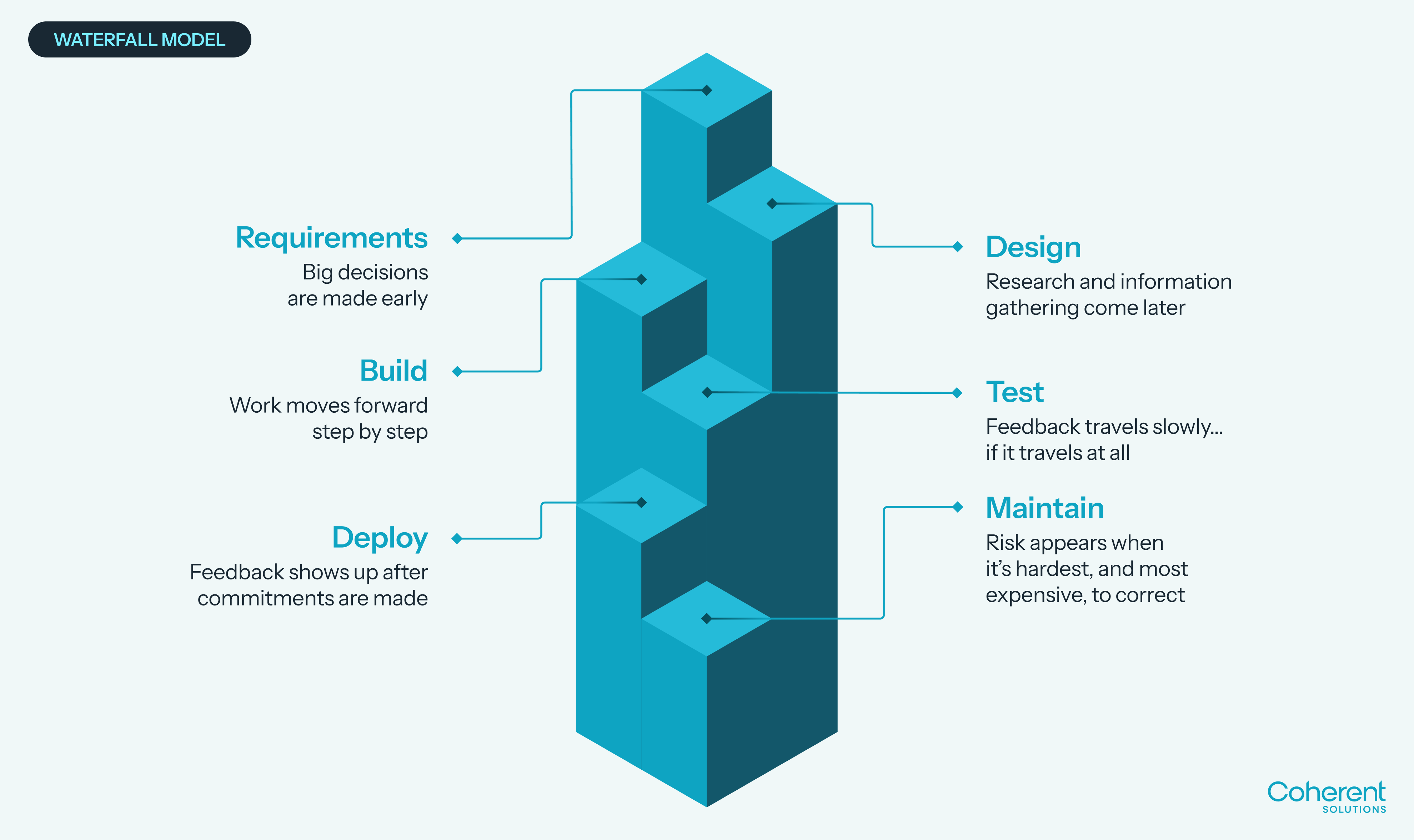
In most organizations, the SDLC is still run as a stage-gated, linear process. Work moves forward step by step. Big decisions are made early, while research and information gathering come later in the process. Feedback travels slowly through workflows and between teams, if it travels at all. This approach worked best when change was predictable, and the goal was to limit variation.
How AI changes the traditional SDLC
When AI is added to the individual phases of a linear SDLC, teams complete phase-specific tasks faster. The system around those tasks, however, doesn’t improve. Handoffs stay rigid. Early assumptions stick. Feedback shows up after commitments are made. Risk appears when it’s hardest, and most expensive, to correct.
The result feels frustratingly familiar to many leaders. While there’s an increase in the speed and productivity of individual phases, there’s no increase in the quality or confidence of the expected outcomes.
We see this often at Coherent Solutions. Organizations invest seriously in AI. Output goes up. Velocity improves. But predictability doesn’t. Outcomes still feel uncertain.
In an AI-native CDL, AI generates insights, moves them across the delivery system, and creates connections between phases. With CDL, decisions improve over time, and learning builds instead of resetting.
Why this shift matters
Organizations compete on delivery speed and predictability. Leaders need to know whether their AI investments are progressing, where risk is building quietly, and whether their efforts are paying off.
The CDL helps improve the entire delivery process by shortening the distance between decision and outcome. Feedback shows up earlier, giving teams a chance to implement changes. Quality, speed, and risk issues are also more visible early in the process, when it’s less challenging (and less expensive) to make adjustments.
It’s also easier to identify value with this approach, whereas in a traditional SDLC, it can be difficult to calculate value prior to release. And by using AI to create these connections and move insights across the delivery process, the system is able to test, adjust, and learn as it goes.
What keeps companies from evolving to a Continuous Delivery Loop
With the obvious limitations of the linear SDLC and AI integrations, you’d assume that most companies would have made the shift to an approach like Coherent’s CDL. It’s easier said than done, however. Organizations aren’t ignoring delivery issues or struggling to access AI tools. They are often derailed by the stress of implementing a new framework. Moving beyond linear SDLC delivery requires a change in how delivery processes operate — shifting team collaboration, progress measurement, and decision validation. The CDL shifts focus from completing activities to improving outcomes, and from optimizing individual steps to understanding system behavior.
This is where many transformations stall. Alignment never fully clicks. Teams move, but not together. Improvements appear, then plateau. Over time, the delivery model itself becomes the limiting factor.
Are you on the path to AI-native delivery?
Organizations that can answer this question honestly and act on it tend to move faster and with more confidence than those trying to modernize outdated software delivery models.
AI will continue evolving, and tools will keep improving. The most successful companies will ensure their delivery systems adapt to these advancements.
With CDL, we work differently. We ask questions early and challenge assumptions when they can still be changed. Delivery is a shared problem to solve, not a plan to follow. When risks are shifted earlier in the process, change is cheaper, and outcomes improve.
At Coherent Solutions, we work with companies navigating this exact shift. We help organizations understand how their delivery systems behave in practice and identify where linear assumptions are limiting AI’s impact. The result is improved quality, speed, and predictability.
SHARE ARTICLE