

With AI and other technological advancements, software ships faster, operations are more automated, and timelines that once took years are now completed in quarters. In digital engineering, modernization at speed is no longer a differentiator — it’s an expectation. Even with organizations investing heavily in AI, cloud infrastructure, and platform overhauls, many are still struggling to improve margins, accelerate growth, or shift their competitive position in any meaningful way. Digital transformation does not automatically translate into business value.
More than ever, companies are looking to bridge that gap between technology investment and business value. Here’s where Coherent Solutions’ Digital Value Creation (DVC) framework can help. DVC puts business impact first, anchoring every digital initiative to a measurable outcome rather than to the technology change itself.
Technology alone does not create business value
A new AI tool, for example, can streamline workflows, automate tasks, and boost productivity. Teams are capable of producing more at a faster rate. The tool, however, doesn’t automatically translate into high-level business value (e.g., improved revenue or customer loyalty). That type of value only emerges when the technology capabilities also affect how the business operates, how customers experience the organization, and how decisions get made.
This explains why many technically successful transformations fail to generate measurable business impact. Organizations can modernize infrastructure, deploy AI, automate workflows, and improve engineering practices, but the day-to-day operational behavior barely changes.
The path to value creation
Organizations that focus on technology transformation alone tend to stop somewhere in the middle. The result is expensive modernization without meaningful business change.
While organizations struggle to connect business value to a range of technology initiatives, including cloud migration and architecture modernization, AI presents unique considerations. Companies are expected to have an AI strategy — even if they’re unsure what it should be. Additionally, many companies are unprepared to execute the strategy and close the loop between AI and business outcomes.
A company can integrate AI into dozens of workflows, accelerate software delivery, and automate operations, yet see very little measurable improvement in revenue growth, margins, customer retention, or competitive positioning. AI doesn’t create business value on its own. The real question is where it creates measurable leverage, and whether it’s being measured against the right things.
Markets reward business outcomes, not delivery metrics
In most organizations, the success of digital initiatives is measured by delivery metrics including engineering throughput, deployment frequency, roadmap completion, and automation coverage. For AI initiatives, the usual metrics are model accuracy, automation rates, and productivity measures such as activity volume. While these metrics help operational leaders gauge execution maturity, they don’t translate to enterprise valuation.
The disconnect is often due to the differences in how operational leaders and a company’s board and investors communicate. While operational leaders are concerned with practical delivery system improvements, business leaders are asking another set of questions. Are margins improving? Are new products reaching the market faster without adding operational complexity? Is customer retention holding? Are technology investments generating measurable economic leverage?
The gap between those two conversations — delivery metrics on the operational side and business outcomes in the boardroom — is where most transformation investments quietly fail. And with every dollar invested in AI, that failure becomes harder to ignore.
How Digital Value Creation changes the conversation
For years, digital transformation was treated largely as a technology conversation. Cloud migration signaled modernization. Workflow automation suggested operational maturity. AI adoption implied innovation. Platform overhauls were taken as proof of an organization’s evolution.
What this one-sided conversation was missing, however, was an examination of how these technologies impacted business outcomes. Implementation, on its own, is not a business outcome.
DVC reframes the transformation conversation around measurable enterprise impact rather than implementation milestones. The shift guides organizations to look beyond the basic question of whether technology was deployed successfully. Instead, the focus is on whether that technology changed business performance.
Within a Digital Value Creation context, the value of a cloud migration is based on its ability to improve resilience, scalability, or cost efficiency. AI only matters if it reduces friction, improves decisions, or accelerates outcomes. Faster software delivery strengthens competitive positioning because it improves responsiveness.
A DVC-driven perspective helps leaders couple technology initiatives to business value, before a dime is invested.
Digital Value Creation case studies
A health industry startup facing rapid growth, partnered with Coherent when limited resources and early-stage development processes threatened its product pipeline and customer integrations. Dedicated teams blending the client’s people with Coherent engineers accelerated product delivery, strengthened customer satisfaction and retention, and opened the door to partnerships with large-scale clients. The engagement worked because it was measured against business outcomes, rather than delivery volume.
Coherent also worked with a well-known eyewear brand to develop a virtual try-on solution and an RX transcription tool for eyeglass dispensing. The team used AI to accelerate design processes and improve the customer experience. They applied a DVC lens to ensure the AI would have a measurable business impact. AI matters when it reduces friction, improves experiences, or accelerates workflows tied to business outcomes, not when it simply runs in the background.
Digital Value Creation asks the right questions
When companies integrate DVC into their technology decisions, digital transformation moves beyond a technology implementation exercise into a business performance discipline.
The evolution looks something like this:
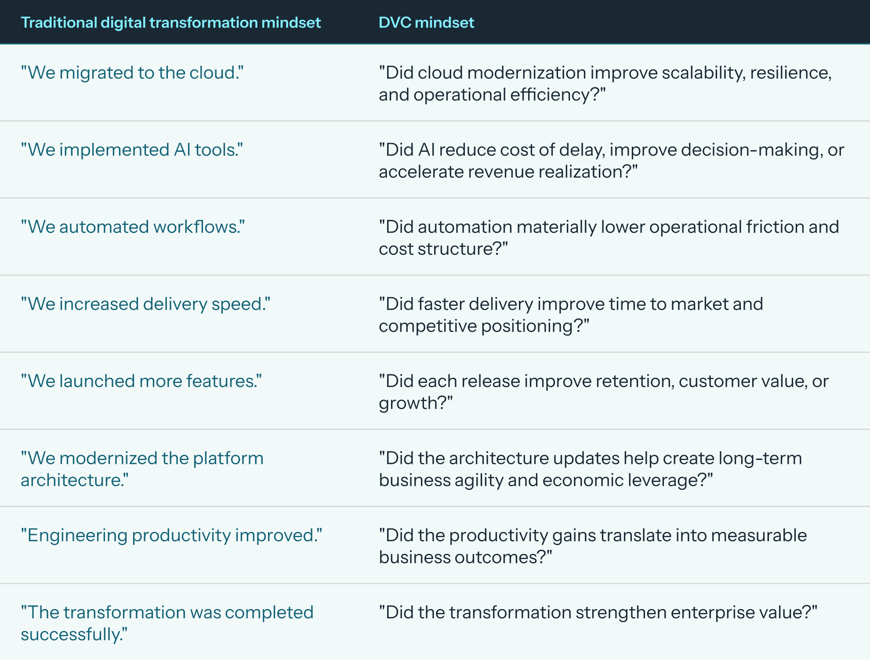
When companies are able to ask and successfully answer questions from a DVC mindset, technology implementation matures into a competitive advantage.
How Digital Value Creation transforms technology partnerships
As the definition of digital success shifts, so does what good technology partnership looks like. Executing a backlog is table stakes.
At Coherent, AI and digital transformation are approached not as isolated technology projects but as tools to accelerate time to market, optimize operating models, modernize platforms, and drive measurable business outcomes.
When approaching AI initiatives, Coherent starts with business outcomes, not technology metrics. The teams apply our Continuous Delivery Loop (CDL) framework, which treats AI delivery as a continuous business optimization cycle, not a one-time implementation.
The market will reward companies that think differently
The strongest companies don’t treat AI as a branding exercise or a standalone initiative. They use it to reshape operating models, improve decision-making, shorten time to market, and build long-term competitive advantages.
If your organization is investing in AI, platform modernization, or digital transformation, it’s time to change the conversation. Instead of asking what you can implement, consider asking how you can use technology to create measurable enterprise value.
SHARE ARTICLE