

As AI pilots multiply under board and investor pressure, two-thirds of CIOs will need to justify their budgets by linking tech spending to business value, according to Forrester. When leadership asks what the spending is actually buying, "we need to move faster on AI" isn't an answer that holds up. Technology leaders have to separate AI's practical value (solving a real problem, cutting cost, saving time, driving revenue) from expensive momentum: money spent because the company feels it has to do AI, with no one able to say what actually changed or who benefited.
That distinction only gets harder to make as pressure builds. Because the largest players in AI, such as Anthropic, OpenAI, Microsoft, and Google, are introducing new platforms and ways of working extremely quickly. And when these company’s novelties start competing with traditional SaaS, they can immediately wipe billions off a company's market value.
Investors need a clear story that links the technology to business value before they pour money into it. Companies that can show them innovation and also build a moat around their solution are more likely to grow in value and become industry benchmarks.
To build that moat, technology leaders should consider the Digital Value Creation framework (DVC), pioneered by Coherent Solutions. DVC enables data-driven decision-making and the strategic use of technology, and promotes the discipline to ask whether next moves ladder up to your company’s aspirational outcomes.
How to create digital value
Only 39% of companies report AI value at the enterprise level, according to McKinsey's 2025 State of AI report. Statistics such as this prove that when it comes to creating real digital value, technology leaders have to deliver on the promises they make to their stakeholders. And it’s not as simple as it sounds.
“Let's say you plan to accelerate production and improve margins using AI. The market will reward that story, at least at first, but then you get stuck at the delivery,” says Shawn Torkelson, Chief Marketing & Strategy Officer.
Companies have so many options that they don’t know what to trust, how to organize their resources, and in what sequence to deploy. If they get it wrong, they risk looking like just another company changing the narrative but not the reality underneath.
The DVC framework suggests taking a pragmatic and grounded approach to technology adoption, moving thoughtfully rather than buying into every new trend. What looks slow in the short term helps build a more stable, scalable technology foundation over time.
Recently, Coherent worked with a leading US fitness and wellness brand to help them build a stable technology foundation. Coherent’s team consolidated siloed systems, modernized APIs, redesigned content platforms, and optimized infrastructure. The immediate result was more than $400,000 in annual IT savings. But the larger value was creating an enterprise backbone — a platform built to support scale with faster delivery, better data, and future-ready AI personalization.

DVC connects experience, delivery, and outcomes
Once organizations have gotten off the technology hype train, they can use DVC to understand the gaps between their current models and the new technology they're looking to implement.
Traditional models start to break down as AI changes software delivery. Companies struggle to estimate material and resource needs before work begins. And when they’re outsourcing development work, they need an engineering partner with AI-native capabilities.
“We’re hearing the same requirements from clients at 80% of our meetings,” says Tom Stallings, Chief Revenue Officer. “They expect us to challenge their way of thinking and, as consultants, take a vested interest in helping them drive success and value creation.”
Alongside AI-native engineering capability, building value requires an understanding of customer needs. The Forrester’s report Center Your Digital Strategy On Customer Outcomes highlights that strong digital strategies are customer-led, insights-driven, fast, and connected, rather than collections of loosely related technology projects.
For companies, the payoff is sharper focus. A customer-led strategy helps separate the technology that looks impressive from the technology that changes how people buy, work, make decisions, and stay loyal.
Using DVC to align technology with business strategy
Companies that use the DVC framework could strengthen partnerships by helping clients focus on what is practical. That approach helps move together beyond project intake and evaluate AI through a business lens.
The gap between technology adoption and value starts to close when everyone asks the right questions, such as "Why are we adopting this technology?" or "Why are we building software this way?"
For example, Coherent’s team looks at the client’s business and suggests where technology can produce measurable results. The goal is to think beyond a perfectly groomed backlog or building to spec, and act as a consulting partner. And the success metric is always the value created in a partnership.
Coherent’s work with Planet Fitness demonstrates how a DVC approach translates into measurable business value. Coherent helped the fitness company evaluate its business needs against its current technology challenges to develop a digital ecosystem that would also serve as a business growth engine. After revamping its platform, Planet Fitness saw a 150% increase in unique mobile users in seven months, a 15% increase in release velocity, and new revenue streams through data-driven upselling.
Creating digital value requires a new operating model
McKinsey surveyed 300 companies and found that only around 16-18% of initiatives scaled across the enterprise. One of the biggest barriers to successfully transitioning to engineering that brings digital value, is people’s willingness to accept how roles evolve and change their ways of working.
In this new engineering approach, the roles shift. For example, a scrum master in a traditional delivery model is not the same in an AI-driven environment where an engineer also acts as an architect, a product thinker, and even orchestrates AI agents.
In one greenfield build, the client’s initial estimate called for a traditional 16-person delivery team. After assessing the product goals, delivery needs, and AI potential, Coherent Solutions determined that the same outcome could be delivered faster with the equivalent of just 4.5 roles. The redesigned team included an AI Solution Architect, an AI Product Intent Lead, and an AI Engineer responsible for full-stack delivery through AI-enabled workflows.
The value came from the operating model. Instead of replacing engineering roles one by one, Coherent structured the team as an AI Pod built around product intent, architecture, and accelerated execution.
Companies should create the conditions for value-driven engineering to work by giving teams a safe space to test, learn, fail, and improve. When people, processes, and technology are ready to work differently, digital value creation can happen.
DVC vs. digital transformation
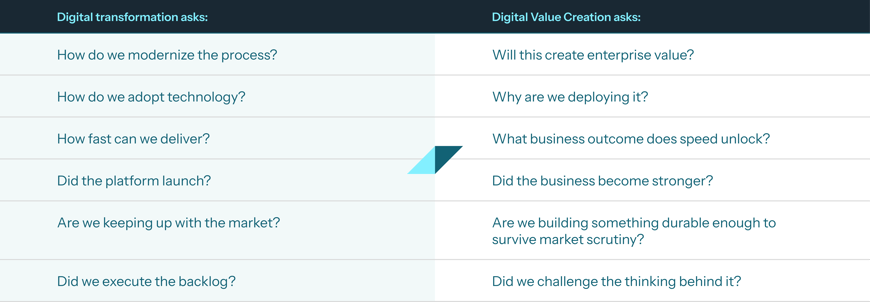
While digital transformation focuses on modernizing individual workflows and processes, DVC’s perspective is holistic, asking whether the technology will help create enterprise value and what organization shifts need to occur to support broader business outcomes.
Prioritizing DVC over transformation can lead to faster growth, greater efficiency, stronger products, and a more competitive market position.
With a side-by-side comparison of digital transformation and DVC, it's easy to see how the questions driving each approach shape the impact companies can create.
In Coherent’s work with Roofle, a home services company, the engineering team used the DVC framework to make strategic technology suggestions and changes. The result was a scalable platform that helped generate revenue and real business value. With the value-driven platform overhaul, Roofle was able to onboard over 1,800 contractors, open new B2B revenue channels, and achieve an average conversion rate of 12%.
Closing the gap between vision and digital value
When it comes to technology implementation, many companies are struggling to see value in their investments. DVC can help close the value gap and help organizations connect high-level business goals with the technology that can help achieve them. The framework also helps companies align with their technology partners to create truly impactful partnerships that move beyond basic implementation strategies to more complex adoption plans that support long-term growth.
Coherent Solutions built the DVC framework to anchor its services and delivery in long-term, durable value. In the current AI hype cycle, DVC helps businesses make more focused technology decisions — prioritizing outcomes over trend adoption and sustainable growth over short-term gains.
SHARE ARTICLE




.jpg)