

Eighteen months into an AI rollout, leaders are usually cautiously optimistic; the copilots are deployed, tools have matured, and adoption numbers look strong. Dashboards are green, and teams are shipping faster. Then they review the quarterly results.
Release schedules remain unpredictable, while defect rates haven't moved, and the revenue impact is hard to trace. Suddenly, the question changes from "how do we accelerate AI adoption?" to "why aren’t we seeing results where it matters?"
At this point, the instinct is to double down — expand the tooling, increase training, tighten governance, and add reviewers. It is a reasonable instinct. It is also the wrong one.
The problem isn’t the pace of the AI tools or teams using them; it is a supporting delivery system that wasn’t built to convert AI activity into business results. In most delivery systems, AI doesn't create this gap; it exposes it. Organizations must address the system-specific structural conditions, such as how intent travels through a delivery chain, how validation keeps pace with output, and how speed, quality, and security work together. Otherwise, they will continue to leverage AI to accelerate work production without increasing value.

Why enterprise AI initiatives stall
To understand why AI programs plateau, it’s helpful to understand the industry’s enterprise AI implementation phases.
In the first phase of enterprise AI, organizations focused on increasing productivity. AI helped engineers write code faster, helped analysts process more data, and helped teams finish tasks quicker. The gains were clear and easy to measure, but they quickly became a baseline expectation.
Now, the second phase requires that organizations turn localized speed into predictable, valuable, and trusted system-wide results. This creates a gap—most AI programs are used in traditional delivery models that aren’t designed to handle the high volume of work AI produces.
The gap is well documented. A recent Forrester Best Practice Report found that 40% of enterprises lack sufficient action and measurable impact from AI. For example, a company could launch 30 pilots and fail to generate any ROI because all the agents just produce dense reports or insights that few act on. McKinsey puts the earnings picture in sharper terms: more than 80% of companies report no material contribution to earnings from their gen AI initiatives, and only 1% view their strategies as mature.
The current issue isn't how to make AI produce more; it's whether the organization can absorb what's being produced and convert it into meaningful business outcomes and ROI.
That distinction (between producing output and delivering value) is the core insight behind Coherent's Digital Value Creation (DVC) framework, which argues that technology only generates enterprise value when it is directly tied to outcomes like higher revenue, lower costs, and greater scalability.
Coordination debt and progress plateaus
Across large engineering organizations, the same three structural problems repeatedly appear in AI initiatives, often coalescing into systemic delivery concerns.
The first problem is signal decay, or the degradation of delivery system transparency. Leaders start with a clear goal, but as it moves through planning, backlog updates, prompts, and generation, the message gets weaker. Each step adds its own interpretation, so by the time work is done, the original goal is far from what gets delivered. This drift from the original delivery goal doesn’t happen all at once. It fades step by step as work is handed off or changed.
The second problem is validation debt. AI produces more output than most teams can manually review and approve. As a result, work piles up, and while teams work hard to clear the backlog, the backlog itself creates a bottleneck that stalls product delivery and negatively impacts business outcomes. Output outpaces decision throughput.
AI is often used to boost product first without considering how to optimize validation workflows with supporting tech and people resources.
The third problem is optimization collision. Across the delivery system, engineering, security, and quality teams are using AI to solve problems. These teams use different tools, unique to their context and needs, and collect metrics to analyze usefulness and impact. This often leads to individual team improvements (streamlined workflows and more efficient processes) but the system does not improve, and the uneven optimization between teams creates unpredictability.
As teams optimize and improve at different rates, they also grow increasingly siloed, widening the gap between activity and value.
Why the usual fixes just don’t work
When organizations hit this plateau and experience one or more of the three structural issues mentioned above, the response is usually “more” — more governance, more metrics, and more reviewers. While these seem like responsible reactions to system-wide delivery problems, none of them address the actual root cause.
Adding more governance to the system introduces extra controls that can help manage risk, but without feedback loops built into the process, the controls add drag without clarity. Furthermore, additional governance doesn’t address the bottleneck; it just increases supervision.
While more metrics would seem to improve value and performance, most organizations only track output volume and adoption rates, which describe activity rather than value. Without knowing which metrics to track, it’s difficult to connect delivery to business outcomes or make strategic decisions that align them.
Finally, many teams try to resolve their growing coordination debt by adding additional reviewers. On paper, it makes sense; if AI output is producing more work than teams can review, simply add more reviewers. Without improving alignment between delivery and business outcomes, or adding feedback loops between workflows, most teams increase the number of reviewers without accelerating decision-making, creating a capacity trap.
The solution: Focus on structure, not just process
In Coherent Solutions’ client projects, the company found that roughly 70% of AI transformation challenges relate to the operating model, while only 30% is tooling. Unfortunately, when most organizations hit an AI progress plateau, they reverse these percentages and focus more on improving tools.
To help clients, Coherent’s teams apply the company’s DVC framework to define key outcomes and its Continuous Delivery Loop (CDL) as a roadmap to help clients achieve those results. With CDL, business intent remains consistent throughout the lifecycle instead of being reinterpreted at each stage.
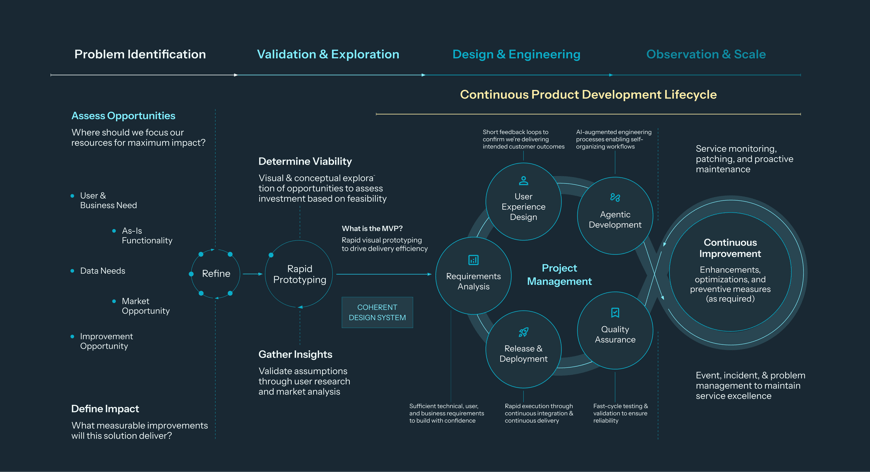
CDL also helps improve those common structural issues in AI initiatives. CDL improves validation by mapping decision rights to risk level. High-stakes changes route to the appropriate human stakeholders, while well-defined, lower-risk work can move through review without manual escalation. This is not about giving AI broader authority; it is about making sure the right judgment is applied at the right threshold.
The core problem identified earlier (output volume outpacing review capacity) is resolved not by scaling the number of reviewers but by restructuring which decisions require human sign-off in the first place. CDL reduces the volume of work that needs manual approval by calibrating review thresholds to the nature of the work, so teams apply approval bandwidth where it matters most.
CDL also addresses optimization collision by creating feedback loops. Rather than letting each team optimize in isolation, CDL establishes structured checkpoints where engineering, security, and quality teams surface blockers, validate shared priorities, and flag when one team's pace is creating friction for another. This shared visibility keeps the full system moving forward together rather than at cross-purposes.
The main benefit of CDL is that it doesn’t impact the additional output AI helps create; it optimizes how the work moves through the delivery system.
Implementing a CDL approach
Pushing past an AI plateau and addressing structural challenges to see real business value doesn’t start at the team level. Instead, executives must first clarify business goals and decide how technology will support them. Other key steps include:
-
Setting a value metric that connects delivery directly to business results. While activity metrics report on output, they do not drive real change.
-
Redesigning one complete delivery loop from start to finish. Beginning with a smaller, focused approach can create a scalable model and demonstrate impact for stakeholders.
-
Delegating ownership and authority across teams. Changing how the delivery system works includes giving individuals control over workflows, not just tools.
Pushing past the AI plateau
In the first phase of enterprise AI, increased activity and output were enough for business value. In this current phase, organizations must turn that activity into lasting, measurable results.
Organizations that rebuild their delivery systems to focus on coordination and value will see more ROI over time, pushing past plateaus to scale both systems and tools and growing returns over time.
SHARE ARTICLE