

Ask almost any fitness executive what they are focused on right now, and the answer is usually the same, engagement outside of the gym. Building community, creating hybrid experiences, and encouraging loyalty are no longer emerging ideas in the industry. They are basic client expectations.
Members want more than a good workout. They want to feel connected to the gym even when they are not there, especially when motivation dips, and routines become harder to maintain. However, very few gyms actually succeed at this.
Creating community matters because members often form a sense of belonging quickly. They’ll ask, "Do I feel comfortable here? Do I see myself coming back?” The answers form early judgments, shaping everything that follows.
Through Coherent Solutions’ work with large fitness brands, including multi-location chains, we’ve seen how often community breaks down during the earliest stages of the member journey. The issues are rarely about motivation or effort. They are usually structural.
When building community, confidence and engagement are not enough
In fitness, community is often misunderstood. It is not defined by social media feeds, challenges, or engagement features. Instead, it shows up in an area that’s often overlooked, consistency. When people attend consistently, they begin to recognize familiar faces.
Consistency is also just a part of the belonging puzzle. If showing up feels awkward or discouraging because people are unable to find members of a similar experience or confidence level, participation fades before a connection can form. It’s a common misconception that community begins with confidence. Confidence grows in community, and without regular attendance and participation, it’s difficult to build either.
Research reinforces this. The Mindbody Wellness Index consistently shows that connection and belonging influence where people choose to work out and whether they stay, often more than price or convenience. In fact, 57% of active consumers are seeking connection within their fitness community.
Community is now a baseline expectation, and it isn’t something you announce. It is something you either build over time or quietly fail to build at all.

The assumptions that quietly break community
In most organizations across industries, including fitness, leaders genuinely want community. They invest in it. They talk about it. They even hire for it. But in practice, community usually feels fragile and difficult to sustain. The disconnect often occurs because community is seen as an afterthought or last-minute addition. Add it after the platform launches. Add it after the app ships. Add it once core functions are live.
And this assumption is rarely challenged. From a digital perspective, everything is working as intended. Your apps and features are checking members in, showing schedules, and processing payments.
In reality, however, while app usage increases, the members’ sense of connection and community doesn’t. Members feel this disconnect most during onboarding and in their first few weeks after joining a gym, when fragmented app and in-person experiences feel disjointed compared to the more continuous experiences they access elsewhere. At Coherent Solutions, we refer to this as the Human Performance Economy. We believe users judge experiences by how well they fit into daily routines and support progress over time, not by how impressive they look on launch day.
What’s missing isn’t effort or intent. It’s prioritizing continuity as a building block of community.
Community starts with behavior, not features
Here’s the truth: gyms that build lasting communities do not begin with features, digital or otherwise. They begin with behavior.
Short-term initiatives can drive activity, but activity alone does not create momentum. What lasts is consistency. Members create attendance routines. They work towards specific goals. They repeat the same efforts over time.
When it comes to consistency, scheduling recurring classes, building training groups, and creating ongoing programs matter. It’s also important, however, to consider behavior: Workout intensity can make or break consistency. People need to participate at a level that feels achievable week after week. When people feel they can keep up, they return. When a program or training group is too hard, they drift away.
The most effective communities are structured so members can pursue similar goals without the need to measure themselves against everyone else. Progress is shared, but it is also personal. The combination of group efforts and personal wins keeps people returning long enough for relationships to form.
It’s essential to acknowledge that members are not just sharing a space. They are sharing efforts, week after week, and that consistent shared behavior is what gives relationships time to form.
If community stops at the door, it cannot last
If the community only exists inside the gym, it is fragile at best. If shared behavior relies solely on physical presence, then momentum and engagement will fade. It isn’t because people lose interest; it’s because the connection stops once they leave the building.
Strong communities extend beyond the facility. They show up in training group chats, weekend activities held outside the gym, and shared fitness goals that continue between sessions.
When members train together, interact outside of the gym, and share progress, the sense of belonging compounds. When connection exists only inside the gym, it resets whenever members leave. When it extends beyond the gym, it grows.
When continuity exists, systems start to matter
Once community is understood as shared behavior over time, the role of systems becomes clear, and it is here that fragmentation can cause real damage.
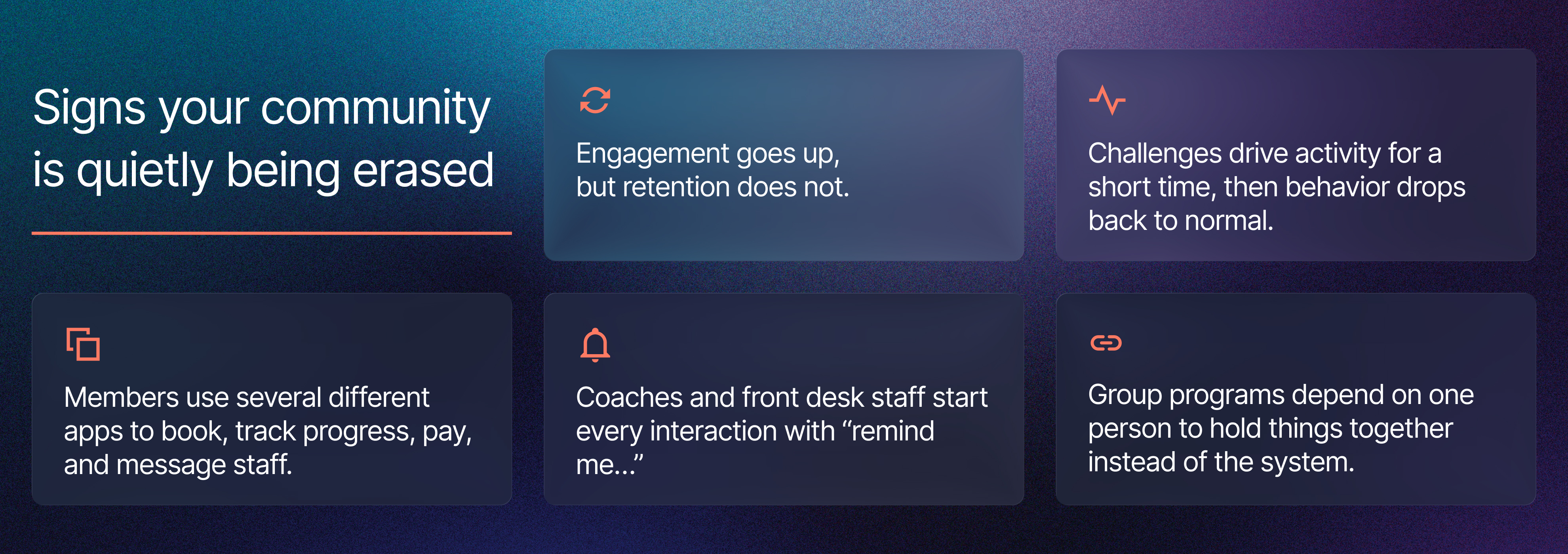
When scheduling, coaching, events, and progress tracking live in separate tools, continuity breaks. Members lose context every time they move between experiences. From their perspective, the gym has no memory.
Organizations that get this right do not use technology to create community. They use it to strengthen it.
We worked with one large fitness company that had years of scattered member profiles and disconnected digital services. Together, we helped them unify the disparate elements into a single ecosystem. Moving forward, the company saw engagement build organically when users and employees weren’t resetting at every touchpoint.
In another project, we helped a leading fitness brand consolidate coaching history, scheduling, challenges, and commerce into one mobile experience. Members could move between in-gym training and outdoor activity without losing progress or context.
The goal is not to generate community through technology, but to use it to support continuity as members move between experiences.

The fitness app’s real job is memory
When fitness apps work best, they preserve context. Their real job is to serve as a collective memory for the community. The app’s collective memory functions should include maintaining a consistent member identity, carrying goals and participation across experiences, and reflecting shared effort over time. When members move between classes, coaching, events, and activities outside the gym, progress should not reset; instead, it should be boosted in the app. Groups should engage in the app and in person. Community history should be visible in app feeds, photos, and forums. Staff should be able to easily reference community highlights and use them to engage with members. The app does not create community. It prevents it from being erased between visits.
In practical terms, this means making it easier for members to discover group activities and track goals across environments, while giving staff enough context to engage with members meaningfully.
The business impact of continuity and community
Shared behavior creates continuity. Continuity supports community. Community increases retention. Retention builds long-term value.
When continuity and community are missing, the effects are subtle but costly. Upselling feels forced, and partnerships stall. Engagement metrics rise while loyalty plateaus. Activity increases, but lifetime value erodes. These effects can be perplexing, but they are not execution failures. They are structural ones.
In subscription-based models, small gains in retention produce outsized returns and it’s well known that the first few months shape whether a member stays or drifts away.
Communities that establish continuity early give engagement time to mature.
Connecting community and leadership
Fitness communities do not fail because gyms lack ideas or effort. They fail because continuity isn’t prioritized, behavior isn’t analyzed, and the supporting technology, such as apps and digital platforms, wasn’t designed as a collective memory repository to help relationships and participation build over time.
The fitness leaders who succeed in building strong communities in their gyms often go against the grain. They design for shared behavior before shipping features. They support experiences that extend beyond the gym. They invest in systems that preserve continuity rather than fragmenting it.
Community is not an add-on. It is a cornerstone that’s non-negotiable for success in today’s Human Performance Economy.
SHARE ARTICLE



-1.jpg)