- Home
- AI-Native Engineering
Path to AI-native engineering
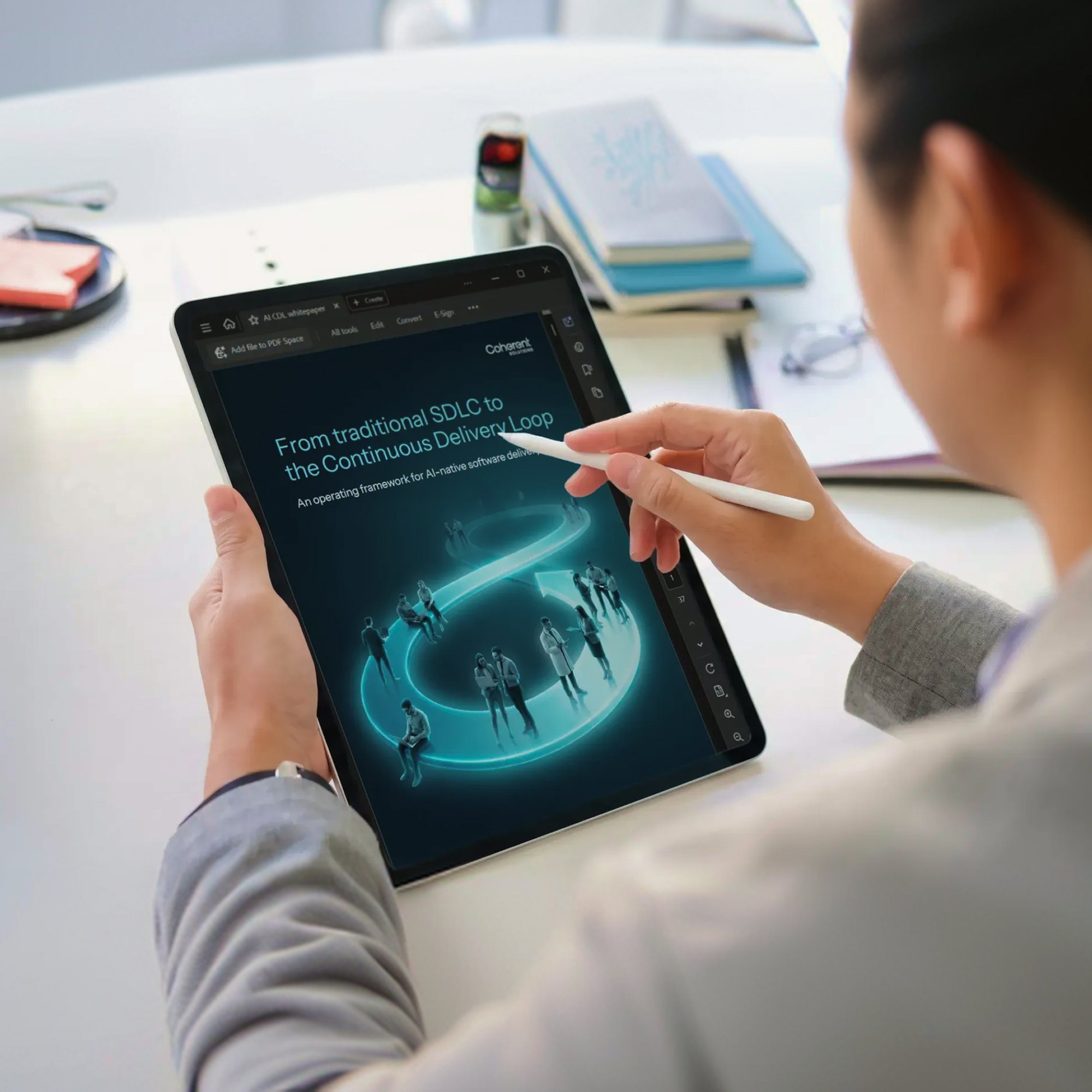
The next wave of software delivery is intent-first and intelligence-driven. Our solution framework embeds this path to AI-native engineering into our Continuous Delivery Loop, resulting in faster software delivery, fewer handoffs, higher and more consistent quality, and compounding efficiency.
Moving from traditional SDLC to AI-native preserves capacity and capital
Traditional SDLC
Software development is predominantly
human-driven.
AI-Assisted
Use of Al to augment discrete phases in the software development lifecycle.
AI-Native
Utilizing AI agents and platforms to create software autonomously.
Standing still drains your resources
Human strategy, oversight, and decision-making are more important than ever to ensure the efficiency of AI native delivery systems.
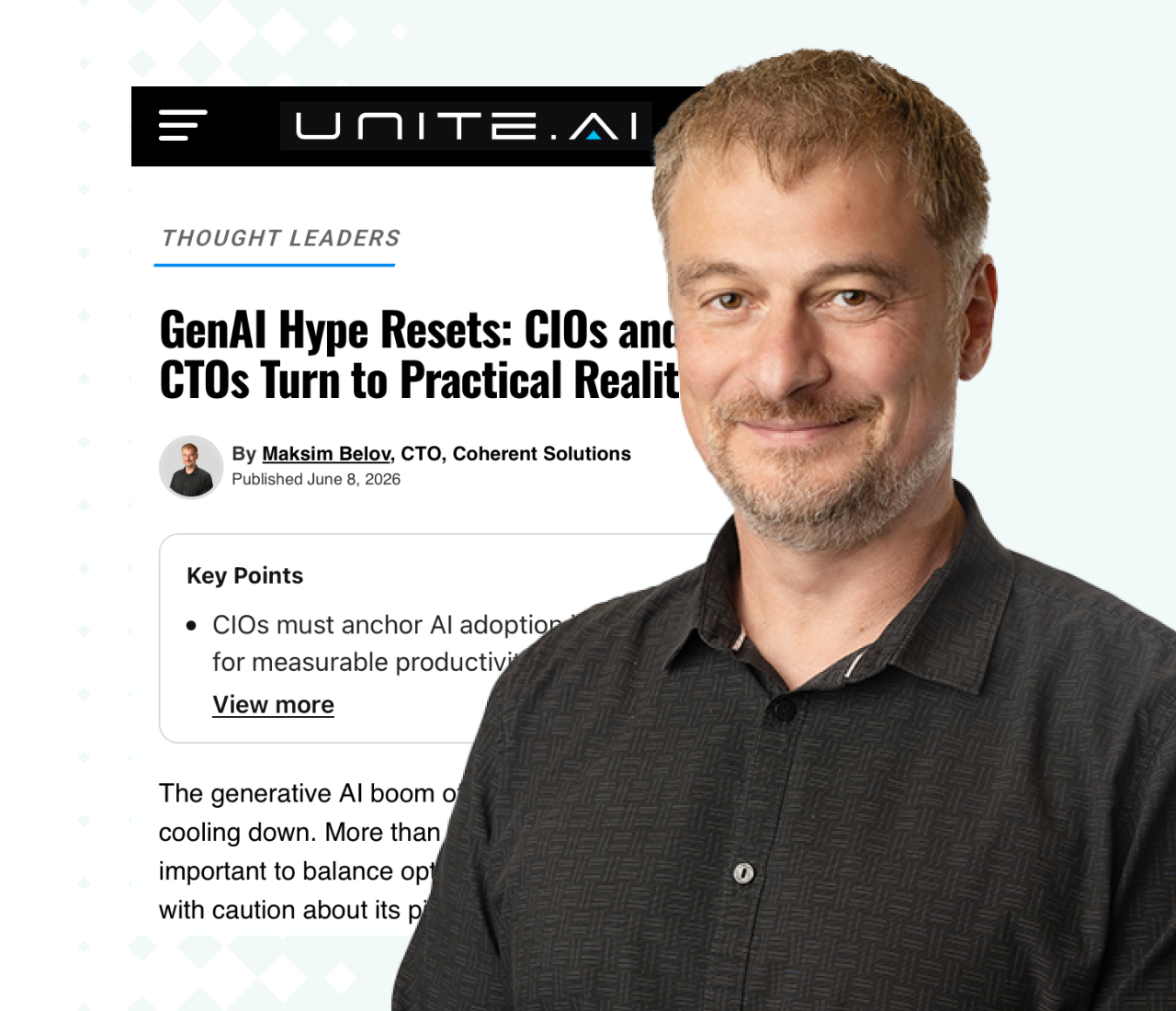
Max Belov
Chief Technology Officer
Coherent Solutions
Continuous Delivery Loop
Our Continuous Delivery Loop is an AI-SDLC that provides clients a bridge to AI-native engineering. It is an operating layer, not a methodology, embedding intelligence across the delivery lifecycle.
Planning becomes data-driven. Execution accelerates. Monitoring turns proactive. The system improves without waiting for a retrospective.
Design
Using our Coherent Design System, clients can lock in visual systems in record time with pre-configured core design components.
AI-enabled rapid prototyping enables clients to quickly envision and validate their outcomes with real users before a line of code is written.
Our proprietary Coherent AI Kit is a curated repository where our client engagement teams can instantly activate production-ready AI prompts, skills, projects, and templates, submitting new AI accelerators for community vetting and promotion.
Case Studies
Our approach
As the client's partner, Coherent Solutions engineered an NLP solution that analyzes online product reviews. Aspect-based sentiment analysis makes it possible to see which product characteristics customers react to, and how, across a large set of reviews.
Cloud engineering and scalable data processing allowed the solution to handle the large volume.
, hide_section_=true, module_id=223641064615}, css={}, child_css={}, id=module_179121423312165, name=module_179121423312165, type=module, order=7, label=Case Study Content Section 2, smart_type=null, styles={}, module_id=223641064615}, module_179121449478468={body={discription=The solution
Coherent Solutions contributed:
- AI and machine learning engineering for a natural language processing solution built on aspect-based sentiment analysis
- Data processing designed for large volumes of customer feedback
- Cloud engineering supporting scalable data processing
The impact
The engagement produced the following results:
- Sentiment identified for specific product characteristics
- Product strengths and weaknesses identified from customer feedback
- Customer feedback processed at scale
The challenge
Reviews often mention several characteristics of a product in the same text, each with its own opinion. An overall review score or sentiment label cannot capture that, and the client needed to know what customers thought about individual characteristics of each product.
The work covered hundreds of thousands of online product reviews, so the solution had to process customer feedback at scale.
, hide_section_=true, module_id=223640941568}, css={}, child_css={}, id=module_179121390029660, name=module_179121390029660, type=module, order=5, label=Case Study Content Section 1, smart_type=null, styles={}, module_id=223640941568}, module_17923271166927={body={hide_show_module_=false, module_id=224756528181}, css={}, child_css={}, id=module_17923271166927, name=module_17923271166927, type=module, order=10, label=Case Study Video Banner Block, smart_type=null, styles={}, module_id=224756528181}, module_179120410606221={body={counter=[], logo_image={src=}, module_id=223627951216}, css={}, child_css={}, id=module_179120410606221, name=module_179120410606221, type=module, order=2, label=Case Study Posts Title, smart_type=null, styles={}, module_id=223627951216}, module_179121475366271={body={discription=What's next
How we worked here is how we work on every engagement. Whatever form your data takes, we start with the questions you need answered, select the right approach, and engineer the data processing and cloud deployment so the answers are ready to be used.
, hide_section_=true, module_id=223641064784}, css={}, child_css={}, id=module_179121475366271, name=module_179121475366271, type=module, order=11, label=case-study-content-section-4, smart_type=null, styles={}, module_id=223641064784}, module_179015393630755={body={heading_group=More Case Studies
, hide_author_name_=false, module_id=224238135902, select_blog=224579243279, select_tag=technology-saas}, css={}, child_css={}, id=module_179015393630755, name=module_179015393630755, type=module, order=12, label=Related Case Study Posts, smart_type=null, styles={}, module_id=224238135902}, module_179121160763349={body={module_id=223636303144, slider_image=[]}, css={}, child_css={}, id=module_179121160763349, name=module_179121160763349, type=module, order=8, label=fullwidth-image-slider, smart_type=null, styles={}, module_id=223636303144}}Our approach
Coherent's team treated the automation layer as a codebase rather than a set of prompts. Everything the team built lived in a versioned, code-reviewed directory checked directly into the repository and structured around three parts.
-
Skills: Sixteen invocable workflows, one for each recurring task, from writing unit tests and drafting pull request descriptions to generating commit messages, building Jira tickets, and investigating a payment.
-
Agents: Five specialist sub-agents, each scoped to a narrow set of tools and a specific job, spawned by the skills that need them.
-
A knowledge corpus: Table schemas, enumeration values, and business-flow documentation, read into every session, so agents work from cached, verified context instead of rediscovering the same facts on every run.
The new automation layer covered ten stages of the team’s delivery lifecycle, including discovery, operations, and even code generation.
-
Discovery: One skill traced a data table's schema straight from source code, cross-referencing the underlying event class, its enums, and its Avro schema, then wrote the result into the knowledge corpus for every other skill to read. The corpus documents itself.
In planning, a Jira skill handled full ticket creation with exact custom-field mappings baked in, so story points, sprint assignment, and epic links landed correctly every time instead of depending on the model to remember conventions. Nothing got written until the engineer had confirmed the epic, the description, the estimate, and the sprint, in that order.
In code review, the team built its highest-leverage automation. A deep review spawns three specialist agents in parallel: one focused on security (OWASP checks, entitlement and brand isolation, webhook signature validation), one on performance (missing timeouts, unfiltered queries against partitioned tables, consumer lag), and one on test coverage. Two run on a more capable model tuned for judgment calls; the third runs on a lighter model tuned for pattern matching, because classifying test gaps doesn't need the same reasoning budget as flagging a security hole. All three report back on a fixed severity scale, with file, line, and fix.
In operations, an incident-investigation skill takes a UUID or a cart ID and fans out in parallel: a query against the data warehouse, a search across the team's incident and alert Slack channels, and a synthesis of the resulting payment timeline into one report. The team's most complex skill recovers failed partner-webhook events from a dead-letter queue, a job with real financial exposure if it goes wrong. It draws a hard line. Scripts own every piece of raw data handling, and the model only makes decisions and confirms them with a person, one webhook at a time, never in a batch.
One rule carried across every skill the team built: the model orchestrates and decides, but deterministic code touches the data. IDs, SQL, and exact field mappings live in scripts, not model output, because that's where hallucination and inconsistency do the most damage.
, hide_section_=true, module_id=223641064615}, css={}, child_css={}, id=module_179121423312165, name=module_179121423312165, type=module, order=7, label=Case Study Content Section 2, smart_type=null, styles={}, module_id=223641064615}, module_179121449478468={body={discription=The impact
Nine months after the operations tooling went live, the AI-driven automation layer has fundamentally changed how the engineering team works. For example, the skill for dead-letter-queue recovery has generated dozens of incident folders, brand correction reports, and recovery runs XX. The client’s engineering team has also seen other system improvements:
- Delivery cycle time from ticket to pull request dropped materially.
- Code review overhead per pull request decreased by hours with the new parallel specialist agents in place.
- Manual documentation effort on architecture and diagrams dropped to nearly zero.
- Cross-team incident response speed increased by 10% to 50%, depending on the investigation.
None of these results came from giving the AI models maximum autonomy. Instead, Coherent focused on giving the agents narrower, well-defined jobs and adding human validation where the risk was highest.
, hide_section_=true, module_id=223640945533}, css={}, child_css={}, id=module_179121449478468, name=module_179121449478468, type=module, order=9, label=Case Study Content Section 3, smart_type=null, styles={}, module_id=223640945533}, module_179121507763678={body={discription=[10% to 50% — speed increase on cross-team incident response, Zero — manual documentation effort after AI implementation, 6 months — from pilot to production-grade tooling], module_id=223640945724}, css={}, child_css={}, id=module_179121507763678, name=module_179121507763678, type=module, order=6, label=case-study-three-column-card, smart_type=null, styles={}, module_id=223640945724}, module_17921485850025={body={module_id=224578905090, quotes_description=, quotes_image={alt=, src=}}, css={}, child_css={}, id=module_17921485850025, name=module_17921485850025, type=module, order=4, label=case-study-full-width-quotes-block, smart_type=null, styles={}, module_id=224578905090}, module_179121390029660={body={discription=The challenge
Payments engineering teams carry a specific kind of overhead. Tickets require careful scoping, pull requests need security and performance reviews, and the context behind incidents must be reconstructed from logs, Slack threads, and data warehouses before they can even start diagnosing the problem. In addition to the built-in operational work, teams are actively working to ship new features.
The client wanted to use AI to absorb more of that overhead, freeing engineering teams to focus on refining and releasing new features. Integrating a technology like AI into payment systems, however, requires additional safeguards to avoid major risks for companies and their clients. Potential issues such as a hallucinated ID, a query against a partition-less table, or an unreviewed production webhook send could cause significant financial harm. For the client, the concern wasn't whether AI could write code for a live payments system, but rather it could be trusted to make judgment calls, and where that trust needs human validation.
, hide_section_=true, module_id=223640941568}, css={}, child_css={}, id=module_179121390029660, name=module_179121390029660, type=module, order=5, label=Case Study Content Section 1, smart_type=null, styles={}, module_id=223640941568}, module_17923271166927={body={hide_show_module_=false, module_id=224756528181}, css={}, child_css={}, id=module_17923271166927, name=module_17923271166927, type=module, order=10, label=Case Study Video Banner Block, smart_type=null, styles={}, module_id=224756528181}, module_179120410606221={body={counter=[], logo_image={src=}, module_id=223627951216}, css={}, child_css={}, id=module_179120410606221, name=module_179120410606221, type=module, order=2, label=Case Study Posts Title, smart_type=null, styles={}, module_id=223627951216}, module_179121475366271={body={discription=What's next
Coherent will continue working with the client as an engineering partner. The dead-letter-queue recovery skill and the rest of the operations tooling continue to handle live incidents, and the payments team can extend the automation layer as new needs arise. What started as one engineer's build has since spread to other teams across the client's engineering organization through the shared internal repository, the same pattern the client has followed with Coherent for six years now, turning one team's tooling into a reference point for the next.
This engagement is a working example of Coherent's Continuous Delivery Loop (CDL) approach in action. CDL is the model Coherent uses in place of a traditional, linear SDLC; it’s built around continuous feedback loops instead of sequential handoffs, bridging the value gap in AI-assisted development. Learn more about CDL.
, hide_section_=true, module_id=223641064784}, css={}, child_css={}, id=module_179121475366271, name=module_179121475366271, type=module, order=11, label=case-study-content-section-4, smart_type=null, styles={}, module_id=223641064784}, module_179015393630755={body={heading_group=More Case Studies
, hide_author_name_=false, module_id=224238135902, select_blog=224579243279, select_tag=retail-consumer-hospitality}, css={}, child_css={}, id=module_179015393630755, name=module_179015393630755, type=module, order=12, label=Related Case Study Posts, smart_type=null, styles={}, module_id=224238135902}, module_179121160763349={body={module_id=223636303144, slider_image=[]}, css={}, child_css={}, id=module_179121160763349, name=module_179121160763349, type=module, order=8, label=fullwidth-image-slider, smart_type=null, styles={}, module_id=223636303144}}Our approach
Coherent’s team built a pilot in six weeks and proved it on the client's own legacy code.
The first attempt used a fully autonomous, agentic AI setup, pushing to minimize human involvement in the migration process. The team hit a wall fast: the app's dynamic UI didn't tolerate loose interpretation, and the context needed to track its complexity burned through the AI's usable window within hours.
So, the team adapted in real time, pivoting mid-engagement. They rebuilt the approach around a defined set of AI-driven skills mapped to each stage of the SDLC — requirements gathering, planning, code generation, testing — with deliberate human checkpoints at every stage. Catching a wrong turn early is far cheaper than untangling it three phases later, and that perspective ensured the team could deliver a working pilot faster than expected.
Additionally, Coherent’s team didn't migrate the entire application at once. They scoped the pilot around the migration of a single, complete user journey and locked that in with the client before writing any new lines of code.
The solution
Coherent’s two engineers delivered the full pilot scope in about six weeks, completing roughly 18%–20% of the application by code. Prior to Coherent joining the project, the client's larger team spent six months on a comparable slice without finishing. Coherent worked with the same legacy codebase and complexity, but completed the pilot in a fraction of the time.
The pilot didn't just produce migrated code. It validated the cost and timeline model for the entire migration, as well as the proposed team structure and roadmap for the project. In other words, the pilot gave the client's leadership team everything it needed to confidently greenlight the full engagement.
The impact
Before the pilot, the client's team estimated that the full migration would take more than two years to complete. After Coherent‘s pilot proved its AI-driven approach, the projected timeline for completing the entire migration came in at six to nine months, with a team of three developers and a part-time architect — a fraction of the original timeline and headcount.
This is what an AI-native migration approach looks like in practice: real speed on real legacy code, with zero impact on the user experience or shortcuts on quality, testing rigor, and fidelity. The client didn't just get a migration plan — Coherent provided a pilot as proof, and a faster path forward.
The challenge
The client’s leadership team wanted to add the application to Android and Windows in addition to iOS, and they wanted it done quickly. Their team, working manually and without Flutter experience, spent six months on the migration with little progress.
The application was a genuinely hard migration target. Its interface was almost entirely dynamic, with screens generated from configuration rather than built individually. As a result, the migration didn’t support screen-by-screen porting; instead, the underlying patterns needed to be rebuilt.
Additionally, there was no technical documentation, automated test coverage, or formal requirements record. The knowledge lived entirely in the heads of the app’s engineers. The app also had to communicate with two parallel server environments, on-prem and cloud, through fixed APIs. And the bar was high for functionality: the rebuilt app had to look and feel identical to users — no visible seams and no rebranding.
, hide_section_=true, module_id=223640941568}, css={}, child_css={}, id=module_179121390029660, name=module_179121390029660, type=module, order=5, label=Case Study Content Section 1, smart_type=null, styles={}, module_id=223640941568}, module_17923271166927={body={hide_show_module_=false, module_id=224756528181}, css={}, child_css={}, id=module_17923271166927, name=module_17923271166927, type=module, order=10, label=Case Study Video Banner Block, smart_type=null, styles={}, module_id=224756528181}, module_179120410606221={body={counter=[], logo_image={src=}, module_id=223627951216}, css={}, child_css={}, id=module_179120410606221, name=module_179120410606221, type=module, order=2, label=Case Study Posts Title, smart_type=null, styles={}, module_id=223627951216}, module_179121475366271={body={discription=What’s next
Coherent's Continuous Delivery Loop (CDL) is the operating framework we use to move clients from traditional development toward AI-native delivery through checkpointed steps and focused technology investment. CDL builds human oversight into the process across four activity centers. Those are problem identification, validation and exploration, design and engineering, and observation and scale. This pilot is a live example of CDL in action. The checkpoint-driven model that made this migration faster is the discipline we bring to our AI-native engagements.
, hide_section_=true, module_id=223641064784}, css={}, child_css={}, id=module_179121475366271, name=module_179121475366271, type=module, order=11, label=case-study-content-section-4, smart_type=null, styles={}, module_id=223641064784}, module_179015393630755={body={heading_group=More Case Studies
, hide_author_name_=false, module_id=224238135902, select_blog=224579243279, select_tag=retail-consumer-hospitality}, css={}, child_css={}, id=module_179015393630755, name=module_179015393630755, type=module, order=12, label=Related Case Study Posts, smart_type=null, styles={}, module_id=224238135902}, module_179121160763349={body={module_id=223636303144, slider_image=[]}, css={}, child_css={}, id=module_179121160763349, name=module_179121160763349, type=module, order=8, label=fullwidth-image-slider, smart_type=null, styles={}, module_id=223636303144}}Ready to accelerate your path to AI-native engineering?
Connect with our AI experts to learn more about our approach.
Relevant
Questions
AI-assisted development uses AI to speed up specific phases, like writing tests or generating boilerplate, while humans still drive the overall process. AI-native delivery uses AI agents and platforms to plan, execute, and adapt across the lifecycle with far less manual handoff between stages.
The cost compounds rather than stays fixed, so competitors ship faster, iterate on more feedback cycles, and reduce delivery overhead, while traditional teams face rising relative costs per feature shipped. The gap tends to widen quietly until it becomes difficult to close.
The distinction is architectural, not tool-based. AI-native teams have restructured their workflows so AI agents participate in planning and execution, not just accelerating isolated tasks. A team using AI-assisted inside an otherwise unchanged process hasn't become AI-native; it's still traditional SDLC with faster typing.
Rapid prototyping validates an idea with real users cheaply and quickly, before committing engineering resources to a full build. Building the full application first means design flaws or misaligned assumptions are only discovered after the more expensive work is already done.
Reusable tooling removes repetitive setup work and lets teams start from a proven baseline instead of solving the same problem from scratch each time. It also reduces variability in quality across teams, since accelerators are vetted before being made available broadly. Ungoverned AI tooling leads to inconsistent quality and duplicated effort, since every engineer solves prompting and configuration problems independently. A vetted, shared repository ensures teams build on tested, production-ready accelerators rather than reinventing them under time pressure.
Retrospectives improve a process only every few weeks at best, whereas continuous feedback loops surface issues and improvements as they arise. The benefits increase over time as teams constantly correct course rather than carry inefficiencies until the next scheduled review.