- Home
- Coherent Continuous Delivery Loop (CDL)
From traditional SDLC to our Continuous Delivery Loop
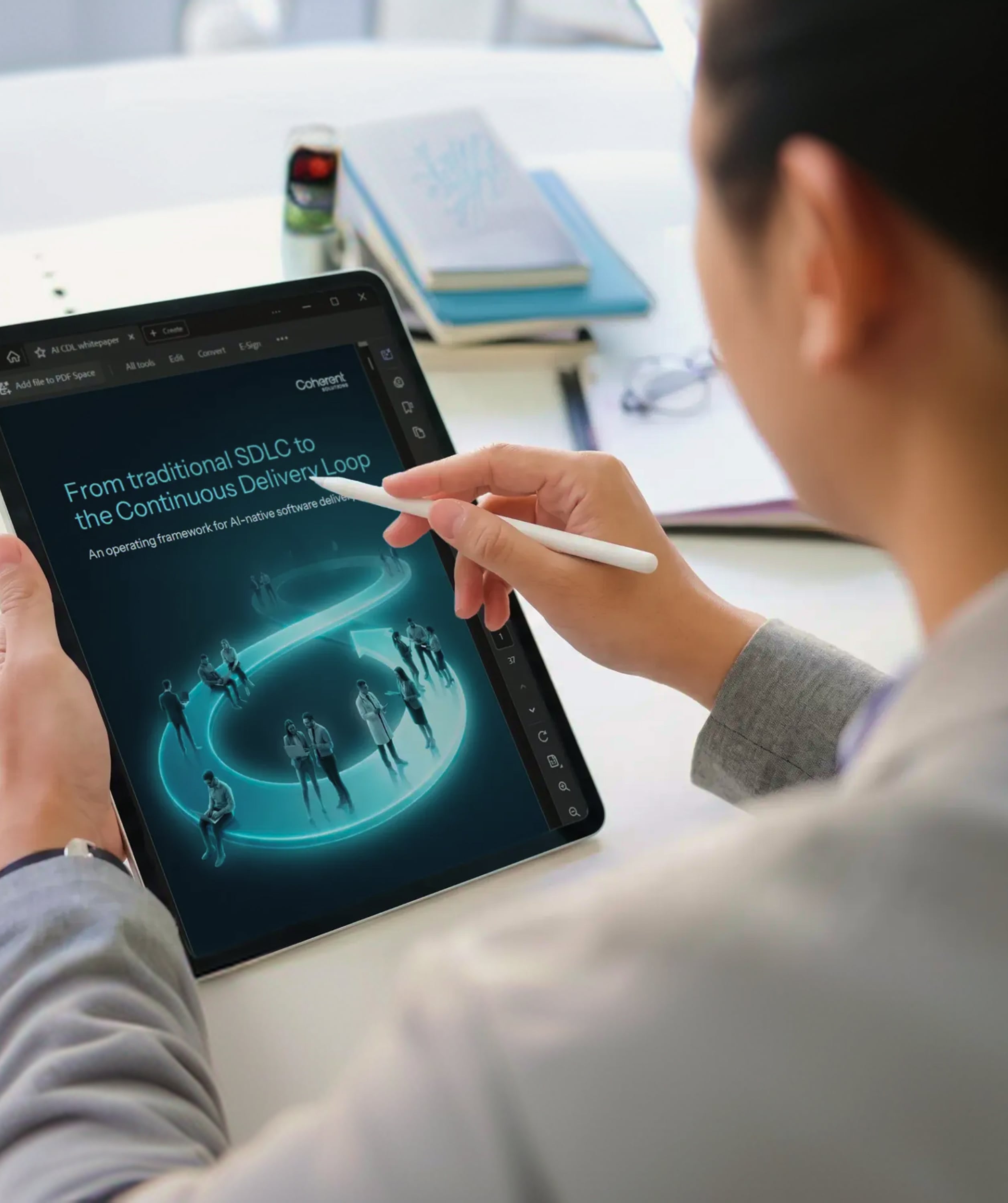
The Coherent Continuous Delivery Loop is an operating model for AI-native software delivery. AI tools alone deliver 10% average productivity acceleration across the SDLC. Our redesigned delivery loop delivers 3x.
Most delivery still stops at release
AI helps engineers work faster, but this speed hasn’t led to quicker delivery, better quality, or more reliable releases. The delivery system hasn’t kept pace with AI, and the gap is widening.
How our Continuous Delivery Loop works
We have reimagined software delivery from the ground up to create a new AI-SDLC.
Most organizations can achieve AI-assisted delivery by using AI to improve individual tasks. But the ways of working, culture, and governance remain unchanged.
To address this gap, we created the Continuous Delivery Loop as an operating framework to connect AI-enabled delivery workflows and processes into a managed system.
Problem Identification
Before a line of code is written, our Continuous Delivery Loop begins each project by defining business goals, not just generating a list of tasks.
Using Coherent’s Digital Value Creation framework, teams identify solutions that ladder up to aspirational outcomes and prioritize these outcomes by enterprise impact.
Validation & Exploration
Once the team identifies initiatives anchored to value creation, they move on to the Validation & Exploration activity center, going beyond the typical market research and competitive analysis completed at the beginning of a traditional SDLC.
Within this activity center, use purpose-specific AI tools to ideate and build rapid prototypes that ensure stakeholder alignment, expose incorrect assumptions, and pressure-test a technical direction before undertaking more substantial development.
Design & Engineering
In this activity center, our Continuous Delivery Loop collapses the traditional SDLC chain into an orchestrated workflow in which role-specific AI agents work alongside human leads across design, development, code review, QA, DevOps, and documentation.
Structured artifacts from prior activities are used as the foundational working context, with AI agents supporting by translating concepts and system requirements into experience designs and code, dynamically generating and executing tests at code changes, opening pull requests for routine work, running AI-led peer review on changes prior to human review, and keeping documentation in lockstep with code updates.
Observation & Scale
In the Observation & Scale activity center, compound learning extends beyond loops to encapsulate learning across the entire delivery system.
Once a release is promoted to production, teams can easily measure what was delivered against the baseline metrics.
Here, AI plays a supporting role, summarizing telemetry into patterns, clustering incidents and user behavior into themes, and drafting first-pass post-mortems and root cause hypotheses from observability data.
Get started on your path to AI-native software delivery
- The 10% code-gen ceiling
- The Digital Value Gap
- Knowledge leakage
- Velocity that plateaus
A tool-first approach is not enough. AI-assisted engineering leaves enterprise value on the table.
Your team adopted AI tools. Commit frequency increased. However, business-critical OKRs did not move.
Activity acceleration does not improve outcomes or create enterprise value. Tools alone cannot fix inefficient processes or drive behavioural change. Our Continuous Delivery Loop approach to AI-native delivery captures the AI value upside.
Your team may complete tasks faster, but feedback comes only at the end. Risks can build up quietly between steps. You often learn if you built the right thing only after the work is done.
The difference between what tool-only AI provides (10%) and what our Continuous Delivery Loop operating framework achieves (30%) is what we call the Digital Value Gap.
Our Continuous Delivery Loop is deliberately tool-agnostic. The operating framework is the durable layer, with the AI tools beneath it being interchangeable, because the tools will likely be replaced several times over the life of any enterprise delivery system.
When someone changes roles or leaves a team, the project context walks out with them.
AI cannot compensate for context that was never captured. Every handoff is a data loss event.
Our Continuous Delivery Loop keeps feedback moving throughout the entire delivery system without stopping and starting at each “phase.” The feedback loops hold the process together, while the operating framework keeps it running.
Local, individual, or siloed optimization just accelerates activity, not output or outcomes.
Teams that adopt copilots see gains in the first quarter, then flatline. This is not because the tools failed, but because the delivery structure around them did not adapt.
Our Continuous Delivery Loop properly leverages cycle velocity for true performance enhancement. Isolated tools will keep evolving. The operating framework is what compounds performance.
- Step 1: Assess
- Step 2: Map
- Step 3: Activate
Start with a diagnostic review of your SDLC.
Dimension-level scoring, stakeholder variance analysis, risk signals, and a 90-day activation plan.
A working session with your delivery leadership. Facilitated by a Coherent AI Expert.
Know where you stand. Know what is next.
Before you can move forward on your path to AI-native engineering, you need to know where you are today.
We map your delivery maturity across three stages: Exploring AI, Adopting AI, Embedding AI. And your next move matters more than your starting point.
Activate our Continuous Delivery Loop
AI, governance, and learning must be built into your day-to-day development cycle.
Our Continuous Delivery Loop is adopted into your delivery system through a four-stage activation, governed by a federated operating model. Cycle after cycle, the loop will strengthen, and your AI maturity will advance.
Our activation plan:
From start to AI-native
Phase 1 (first week): Preparation and planning
- Align on business use cases and delivery metrics
- Select and standardize one AI coding assistant
- Establish baseline metrics: adoption %, velocity, defect leakage rate
- Identify skill gaps, plan training, assign AI Experts

Phase 2 (first month): Baseline setup
- Set up AI delivery assets
- Workflow-specific team upskilling
- Codify learnings into the AI Playbook
- Set up personalized AI assets
- Activate cadence between AI CoE and AI Experts

Phase 3 (immersion): AI integration in delivery
- Our AI Experts support delivery across 2–3 backlog items
- Team integrates AI in daily workflow, in real sprint work
- Capture feedback on value and friction

Phase 4 (operational): Measure, learn & scale
- Measure, learn, scale
- Document outcomes: What works, what doesn't, what to improve next
- Continuous improvement: Tweak governance, update knowledge, refresh assets

We meet you where you are and build a roadmap that makes sense for your business, your teams, and your timelines
Case Studies
Bringing AI-native engineering to a food delivery platform
Our approach
As the client's partner, Coherent Solutions engineered an NLP solution that analyzes online product reviews. Aspect-based sentiment analysis makes it possible to see which product characteristics customers react to, and how, across a large set of reviews.
Cloud engineering and scalable data processing allowed the solution to handle the large volume.
, hide_section_=true, module_id=223641064615}, css={}, child_css={}, id=module_179121423312165, name=module_179121423312165, type=module, order=7, label=Case Study Content Section 2, smart_type=null, styles={}, module_id=223641064615}, module_179121449478468={body={discription=The solution
Coherent Solutions contributed:
- AI and machine learning engineering for a natural language processing solution built on aspect-based sentiment analysis
- Data processing designed for large volumes of customer feedback
- Cloud engineering supporting scalable data processing
The impact
The engagement produced the following results:
- Sentiment identified for specific product characteristics
- Product strengths and weaknesses identified from customer feedback
- Customer feedback processed at scale
The challenge
Reviews often mention several characteristics of a product in the same text, each with its own opinion. An overall review score or sentiment label cannot capture that, and the client needed to know what customers thought about individual characteristics of each product.
The work covered hundreds of thousands of online product reviews, so the solution had to process customer feedback at scale.
, hide_section_=true, module_id=223640941568}, css={}, child_css={}, id=module_179121390029660, name=module_179121390029660, type=module, order=5, label=Case Study Content Section 1, smart_type=null, styles={}, module_id=223640941568}, module_17923271166927={body={hide_show_module_=false, module_id=224756528181}, css={}, child_css={}, id=module_17923271166927, name=module_17923271166927, type=module, order=10, label=Case Study Video Banner Block, smart_type=null, styles={}, module_id=224756528181}, module_179120410606221={body={counter=[], logo_image={src=}, module_id=223627951216}, css={}, child_css={}, id=module_179120410606221, name=module_179120410606221, type=module, order=2, label=Case Study Posts Title, smart_type=null, styles={}, module_id=223627951216}, module_179121475366271={body={discription=What's next
How we worked here is how we work on every engagement. Whatever form your data takes, we start with the questions you need answered, select the right approach, and engineer the data processing and cloud deployment so the answers are ready to be used.
, hide_section_=true, module_id=223641064784}, css={}, child_css={}, id=module_179121475366271, name=module_179121475366271, type=module, order=11, label=case-study-content-section-4, smart_type=null, styles={}, module_id=223641064784}, module_179015393630755={body={heading_group=More Case Studies
, hide_author_name_=false, module_id=224238135902, select_blog=224579243279, select_tag=technology-saas}, css={}, child_css={}, id=module_179015393630755, name=module_179015393630755, type=module, order=12, label=Related Case Study Posts, smart_type=null, styles={}, module_id=224238135902}, module_179121160763349={body={module_id=223636303144, slider_image=[]}, css={}, child_css={}, id=module_179121160763349, name=module_179121160763349, type=module, order=8, label=fullwidth-image-slider, smart_type=null, styles={}, module_id=223636303144}}Our approach
Coherent's team treated the automation layer as a codebase rather than a set of prompts. Everything the team built lived in a versioned, code-reviewed directory checked directly into the repository and structured around three parts.
-
Skills: Sixteen invocable workflows, one for each recurring task, from writing unit tests and drafting pull request descriptions to generating commit messages, building Jira tickets, and investigating a payment.
-
Agents: Five specialist sub-agents, each scoped to a narrow set of tools and a specific job, spawned by the skills that need them.
-
A knowledge corpus: Table schemas, enumeration values, and business-flow documentation, read into every session, so agents work from cached, verified context instead of rediscovering the same facts on every run.
The new automation layer covered ten stages of the team’s delivery lifecycle, including discovery, operations, and even code generation.
-
Discovery: One skill traced a data table's schema straight from source code, cross-referencing the underlying event class, its enums, and its Avro schema, then wrote the result into the knowledge corpus for every other skill to read. The corpus documents itself.
In planning, a Jira skill handled full ticket creation with exact custom-field mappings baked in, so story points, sprint assignment, and epic links landed correctly every time instead of depending on the model to remember conventions. Nothing got written until the engineer had confirmed the epic, the description, the estimate, and the sprint, in that order.
In code review, the team built its highest-leverage automation. A deep review spawns three specialist agents in parallel: one focused on security (OWASP checks, entitlement and brand isolation, webhook signature validation), one on performance (missing timeouts, unfiltered queries against partitioned tables, consumer lag), and one on test coverage. Two run on a more capable model tuned for judgment calls; the third runs on a lighter model tuned for pattern matching, because classifying test gaps doesn't need the same reasoning budget as flagging a security hole. All three report back on a fixed severity scale, with file, line, and fix.
In operations, an incident-investigation skill takes a UUID or a cart ID and fans out in parallel: a query against the data warehouse, a search across the team's incident and alert Slack channels, and a synthesis of the resulting payment timeline into one report. The team's most complex skill recovers failed partner-webhook events from a dead-letter queue, a job with real financial exposure if it goes wrong. It draws a hard line. Scripts own every piece of raw data handling, and the model only makes decisions and confirms them with a person, one webhook at a time, never in a batch.
One rule carried across every skill the team built: the model orchestrates and decides, but deterministic code touches the data. IDs, SQL, and exact field mappings live in scripts, not model output, because that's where hallucination and inconsistency do the most damage.
, hide_section_=true, module_id=223641064615}, css={}, child_css={}, id=module_179121423312165, name=module_179121423312165, type=module, order=7, label=Case Study Content Section 2, smart_type=null, styles={}, module_id=223641064615}, module_179121449478468={body={discription=The impact
Nine months after the operations tooling went live, the AI-driven automation layer has fundamentally changed how the engineering team works. For example, the skill for dead-letter-queue recovery has generated dozens of incident folders, brand correction reports, and recovery runs XX. The client’s engineering team has also seen other system improvements:
- Delivery cycle time from ticket to pull request dropped materially.
- Code review overhead per pull request decreased by hours with the new parallel specialist agents in place.
- Manual documentation effort on architecture and diagrams dropped to nearly zero.
- Cross-team incident response speed increased by 10% to 50%, depending on the investigation.
None of these results came from giving the AI models maximum autonomy. Instead, Coherent focused on giving the agents narrower, well-defined jobs and adding human validation where the risk was highest.
, hide_section_=true, module_id=223640945533}, css={}, child_css={}, id=module_179121449478468, name=module_179121449478468, type=module, order=9, label=Case Study Content Section 3, smart_type=null, styles={}, module_id=223640945533}, module_179121507763678={body={discription=[10% to 50% — speed increase on cross-team incident response, Zero — manual documentation effort after AI implementation, 6 months — from pilot to production-grade tooling], module_id=223640945724}, css={}, child_css={}, id=module_179121507763678, name=module_179121507763678, type=module, order=6, label=case-study-three-column-card, smart_type=null, styles={}, module_id=223640945724}, module_17921485850025={body={module_id=224578905090, quotes_description=, quotes_image={alt=, src=}}, css={}, child_css={}, id=module_17921485850025, name=module_17921485850025, type=module, order=4, label=case-study-full-width-quotes-block, smart_type=null, styles={}, module_id=224578905090}, module_179121390029660={body={discription=The challenge
Payments engineering teams carry a specific kind of overhead. Tickets require careful scoping, pull requests need security and performance reviews, and the context behind incidents must be reconstructed from logs, Slack threads, and data warehouses before they can even start diagnosing the problem. In addition to the built-in operational work, teams are actively working to ship new features.
The client wanted to use AI to absorb more of that overhead, freeing engineering teams to focus on refining and releasing new features. Integrating a technology like AI into payment systems, however, requires additional safeguards to avoid major risks for companies and their clients. Potential issues such as a hallucinated ID, a query against a partition-less table, or an unreviewed production webhook send could cause significant financial harm. For the client, the concern wasn't whether AI could write code for a live payments system, but rather it could be trusted to make judgment calls, and where that trust needs human validation.
, hide_section_=true, module_id=223640941568}, css={}, child_css={}, id=module_179121390029660, name=module_179121390029660, type=module, order=5, label=Case Study Content Section 1, smart_type=null, styles={}, module_id=223640941568}, module_17923271166927={body={hide_show_module_=false, module_id=224756528181}, css={}, child_css={}, id=module_17923271166927, name=module_17923271166927, type=module, order=10, label=Case Study Video Banner Block, smart_type=null, styles={}, module_id=224756528181}, module_179120410606221={body={counter=[], logo_image={src=}, module_id=223627951216}, css={}, child_css={}, id=module_179120410606221, name=module_179120410606221, type=module, order=2, label=Case Study Posts Title, smart_type=null, styles={}, module_id=223627951216}, module_179121475366271={body={discription=What's next
Coherent will continue working with the client as an engineering partner. The dead-letter-queue recovery skill and the rest of the operations tooling continue to handle live incidents, and the payments team can extend the automation layer as new needs arise. What started as one engineer's build has since spread to other teams across the client's engineering organization through the shared internal repository, the same pattern the client has followed with Coherent for six years now, turning one team's tooling into a reference point for the next.
This engagement is a working example of Coherent's Continuous Delivery Loop (CDL) approach in action. CDL is the model Coherent uses in place of a traditional, linear SDLC; it’s built around continuous feedback loops instead of sequential handoffs, bridging the value gap in AI-assisted development. Learn more about CDL.
, hide_section_=true, module_id=223641064784}, css={}, child_css={}, id=module_179121475366271, name=module_179121475366271, type=module, order=11, label=case-study-content-section-4, smart_type=null, styles={}, module_id=223641064784}, module_179015393630755={body={heading_group=More Case Studies
, hide_author_name_=false, module_id=224238135902, select_blog=224579243279, select_tag=retail-consumer-hospitality}, css={}, child_css={}, id=module_179015393630755, name=module_179015393630755, type=module, order=12, label=Related Case Study Posts, smart_type=null, styles={}, module_id=224238135902}, module_179121160763349={body={module_id=223636303144, slider_image=[]}, css={}, child_css={}, id=module_179121160763349, name=module_179121160763349, type=module, order=8, label=fullwidth-image-slider, smart_type=null, styles={}, module_id=223636303144}}Our approach
Coherent’s team built a pilot in six weeks and proved it on the client's own legacy code.
The first attempt used a fully autonomous, agentic AI setup, pushing to minimize human involvement in the migration process. The team hit a wall fast: the app's dynamic UI didn't tolerate loose interpretation, and the context needed to track its complexity burned through the AI's usable window within hours.
So, the team adapted in real time, pivoting mid-engagement. They rebuilt the approach around a defined set of AI-driven skills mapped to each stage of the SDLC — requirements gathering, planning, code generation, testing — with deliberate human checkpoints at every stage. Catching a wrong turn early is far cheaper than untangling it three phases later, and that perspective ensured the team could deliver a working pilot faster than expected.
Additionally, Coherent’s team didn't migrate the entire application at once. They scoped the pilot around the migration of a single, complete user journey and locked that in with the client before writing any new lines of code.
The solution
Coherent’s two engineers delivered the full pilot scope in about six weeks, completing roughly 18%–20% of the application by code. Prior to Coherent joining the project, the client's larger team spent six months on a comparable slice without finishing. Coherent worked with the same legacy codebase and complexity, but completed the pilot in a fraction of the time.
The pilot didn't just produce migrated code. It validated the cost and timeline model for the entire migration, as well as the proposed team structure and roadmap for the project. In other words, the pilot gave the client's leadership team everything it needed to confidently greenlight the full engagement.
The impact
Before the pilot, the client's team estimated that the full migration would take more than two years to complete. After Coherent‘s pilot proved its AI-driven approach, the projected timeline for completing the entire migration came in at six to nine months, with a team of three developers and a part-time architect — a fraction of the original timeline and headcount.
This is what an AI-native migration approach looks like in practice: real speed on real legacy code, with zero impact on the user experience or shortcuts on quality, testing rigor, and fidelity. The client didn't just get a migration plan — Coherent provided a pilot as proof, and a faster path forward.
The challenge
The client’s leadership team wanted to add the application to Android and Windows in addition to iOS, and they wanted it done quickly. Their team, working manually and without Flutter experience, spent six months on the migration with little progress.
The application was a genuinely hard migration target. Its interface was almost entirely dynamic, with screens generated from configuration rather than built individually. As a result, the migration didn’t support screen-by-screen porting; instead, the underlying patterns needed to be rebuilt.
Additionally, there was no technical documentation, automated test coverage, or formal requirements record. The knowledge lived entirely in the heads of the app’s engineers. The app also had to communicate with two parallel server environments, on-prem and cloud, through fixed APIs. And the bar was high for functionality: the rebuilt app had to look and feel identical to users — no visible seams and no rebranding.
, hide_section_=true, module_id=223640941568}, css={}, child_css={}, id=module_179121390029660, name=module_179121390029660, type=module, order=5, label=Case Study Content Section 1, smart_type=null, styles={}, module_id=223640941568}, module_17923271166927={body={hide_show_module_=false, module_id=224756528181}, css={}, child_css={}, id=module_17923271166927, name=module_17923271166927, type=module, order=10, label=Case Study Video Banner Block, smart_type=null, styles={}, module_id=224756528181}, module_179120410606221={body={counter=[], logo_image={src=}, module_id=223627951216}, css={}, child_css={}, id=module_179120410606221, name=module_179120410606221, type=module, order=2, label=Case Study Posts Title, smart_type=null, styles={}, module_id=223627951216}, module_179121475366271={body={discription=What’s next
Coherent's Continuous Delivery Loop (CDL) is the operating framework we use to move clients from traditional development toward AI-native delivery through checkpointed steps and focused technology investment. CDL builds human oversight into the process across four activity centers. Those are problem identification, validation and exploration, design and engineering, and observation and scale. This pilot is a live example of CDL in action. The checkpoint-driven model that made this migration faster is the discipline we bring to our AI-native engagements.
, hide_section_=true, module_id=223641064784}, css={}, child_css={}, id=module_179121475366271, name=module_179121475366271, type=module, order=11, label=case-study-content-section-4, smart_type=null, styles={}, module_id=223641064784}, module_179015393630755={body={heading_group=More Case Studies
, hide_author_name_=false, module_id=224238135902, select_blog=224579243279, select_tag=retail-consumer-hospitality}, css={}, child_css={}, id=module_179015393630755, name=module_179015393630755, type=module, order=12, label=Related Case Study Posts, smart_type=null, styles={}, module_id=224238135902}, module_179121160763349={body={module_id=223636303144, slider_image=[]}, css={}, child_css={}, id=module_179121160763349, name=module_179121160763349, type=module, order=8, label=fullwidth-image-slider, smart_type=null, styles={}, module_id=223636303144}}Ready to accelerate your path to AI-native engineering?
Connect with our AI experts to learn more about our approach.
Relevant
Questions
AI-assisted delivery applies AI to specific tasks within an otherwise unchanged SDLC, producing modest, often plateauing gains. An AI-native operating model restructures the delivery system itself so AI is embedded across planning, execution, and feedback, which is what unlocks compounding rather than one-time gains.
Tools accelerate individual tasks like writing or reviewing code, but if the surrounding process, governance, and culture stay the same, that speed doesn't reach the metrics leadership actually cares about. Activity increases; outcomes often don't move with it.
AI tools change fast, and enterprise delivery systems need to outlast several generations of them. A tool-agnostic framework keeps the operating structure stable while individual tools are swapped in and out over time, rather than rebuilding the whole system with every new tool release.
Sprint-based iteration still batches feedback into fixed intervals, meaning issues can sit unaddressed until the next cycle. Continuous delivery feedback flows constantly across the system, so learning and correction happen in near real time rather than waiting for a scheduled checkpoint.
Maturity measures how well AI is embedded into governance, workflows, and team behavior — not how many AI tools a team has installed. Two teams can have identical tools and very different outcomes, because maturity reflects how deeply those tools are integrated into the actual delivery system.
Without governance, AI adoption tends to happen inconsistently across teams, creating uneven quality and duplicated effort. A federated operating model sets shared standards while still allowing individual teams enough flexibility to apply them to their own context.