- Home
- Digital Experience
Digital Experience
Representing the user experience pillar of our Digital Value Creation framework, our UX/UI design services help you create exceptional experiences and interfaces that convert, engage, and differentiate.
Extraordinary is our norm.

Ownership
Talent and experience alone don’t guarantee outcomes. Our team works with you to own the outcome.

Purpose
Design isn't here to impress, it's here to serve. Every decision should answer to a real purpose; help someone do something, solve a user need, or support a business goal.

Launch
Launching is our standard. Design that doesn’t reach production is just an expensive exercise. We work closely with our engineers to think beyond the screen.
Digital Experience Capabilities
We design user experiences competitors can’t replicate to turn users into fans.
User Research & Discovery
Our user research services transform assumptions into validated direction, helping you prioritize features that matter and reduce risk before development.
UX/UI Visual Design
We design intuitive, multimodal, and high-performance interfaces that convert users into brand loyalists. Grounded in behavioral data, every screen is built to minimize friction and accelerate adoption.
Usability Testing & Optimization
We turn continuous testing into a competitive advantage by combining analytics, user feedback, and predictive modeling to identify friction points early, run rapid experiments, and iterate toward seamless experiences.
Design Systems & Component Libraries
We architect reusable systems that unite design and code into a single, production-ready, accessible, version-controlled framework, enabling faster delivery and consistent experiences.
Additional Capabilities
Explore these additional capability pillars from our Digital Value Creation framework.
We work with you to build AI-enabled products and platforms that turn emerging tech into a competitive advantage.
Our global data engineering, business intelligence, and analytics practice builds scalable systems that enable decisions to be made while opportunities still exist.
With thousands of engineers worldwide, our stable software delivery practices lead to faster time-to-market, infrastructure resiliency, and smoother releases.
AI x Ideation FastTrack
Partner with our team to Mock'n'Roll through your concepts, get instant feedback, and inform refinements by leveraging our product design expertise, Claude Code, and our Coherent Design System (CDS) before investing resources in full-scale development.
AI-enabled delivery approach, backed by industry expertise
Our capabilities are delivered by a global team of experts with significant depth across industry domains.
Our approach
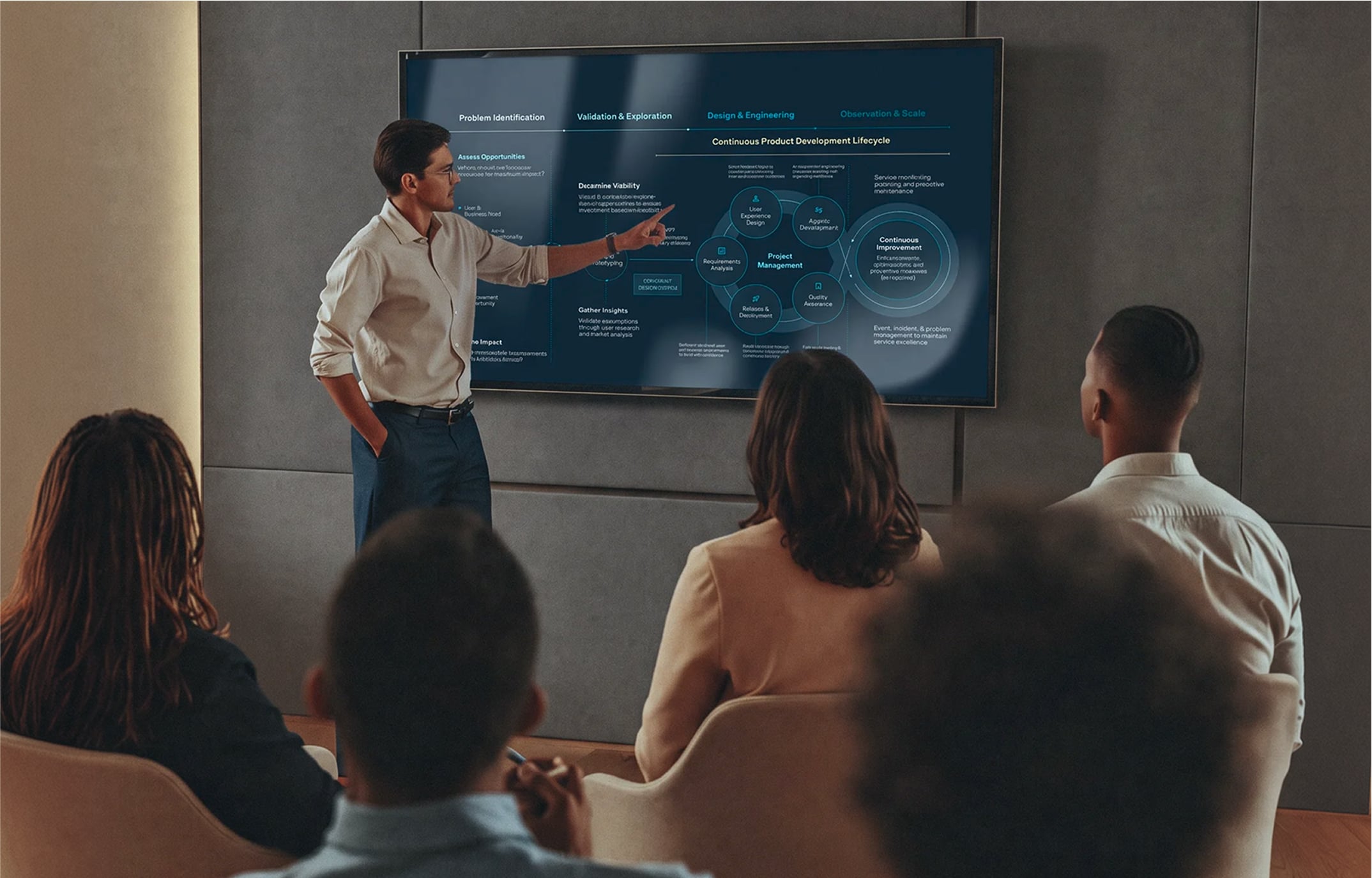
Our delivery operating model embeds AI-native engineering practices into our unique Continuous Delivery Loop.

Industry expertise
We blend your industry context with our technical mastery to achieve aspirational outcomes that create value and address your unique challenges.
Case Studies
RoofQuote PRO: Building the ultimate AI-powered roofing solution

Our approach
With little formal documentation to lean on, Coherent’s team relied on frequent, direct conversations with the client’s technical staff to confirm new features as they completed each step of the project:
- Codebase archaeology and consolidation: engineers worked through the four mismatched mobile repositories, cross-referenced them against the live app store build, and reconstructed the most current working codebase before making any changes.
- Environment separation: introduced dedicated development, QA, and production environments in place of the single, undifferentiated setup the client had been running.
- Cloud infrastructure cleanup: rebuilt cloud build pipelines and restructured infrastructure, improving reliability, while bringing monthly cloud costs down from roughly $8,000 to about $1,500, an 81% reduction.
- New device API: built a new backend API, on a Grails and Java/Spring stack, that takes raw measurements from the client's new refraction-testing hardware, applies the client's formula, and returns validated results ready for review by a licensed doctor.
The solution
Today, the platform supports a complete at-home vision-testing workflow. Users complete a guided assessment with the client's hardware, results are processed through Coherent-built backend logic, and outcomes are routed to a licensed eye care professional for a prescription. The underlying infrastructure now runs across separate dev, QA, and production environments at a fraction of its previous cloud cost, giving the client a stable foundation to build on as it brings new devices to market.
The impact
- 81% reduction in monthly cloud costs, from about $8,000 to about $1,500
- New device API delivered in about 9 months, supporting the client's newest hardware line
- New development, QA, and production environments to replace the client’s single setup, consolidating four mismatched mobile repositories into one working codebase
The challenge
An undocumented, fragmented codebase
Before building the API or writing new code, Coherent needed to identify the code currently driving the client’s companion app. With no product requirements documentation and four mismatched repositories to sort through, they had to cross-reference what was on old developer laptops against the live versions in the app stores.
No environment separation and rising cloud costs
The client’s systems and software were running in a single environment — without a clear separation between development, QA, and production — which increased the likelihood of issues like cascading errors. Additionally, cloud infrastructure spend was disproportionate to the size of the product, running close to $8,000 per month.
New hardware, new math
The client was bringing a new device to market that paired with the user’s smartphone and measured refractive error using patented optical technology. Coherent needed to build the backend logic that would take the client's proprietary formula, apply it to raw device measurements, and return an accurate, prescription-ready result.
, hide_section_=true, module_id=223640941568}, css={}, child_css={}, id=module_179121390029660, name=module_179121390029660, type=module, order=5, label=Case Study Content Section 1, smart_type=null, styles={}, module_id=223640941568}, module_17923271166927={body={hide_show_module_=false, module_id=224756528181}, css={}, child_css={}, id=module_17923271166927, name=module_17923271166927, type=module, order=10, label=Case Study Video Banner Block, smart_type=null, styles={}, module_id=224756528181}, module_179120410606221={body={counter=[], logo_image={src=}, module_id=223627951216}, css={}, child_css={}, id=module_179120410606221, name=module_179120410606221, type=module, order=2, label=Case Study Posts Title, smart_type=null, styles={}, module_id=223627951216}, module_179121475366271={body={discription=What's next
Through AKTIV, Coherent’s dedicated fitness and wellness practice, the company will continue to support the client’s ongoing platform enhancements across mobile, backend, DevOps, QA, and project management. Using the same consumer healthtech context that shaped the client’s rebuild, AKTIV's engineers will also ensure the client’s hardware, app, and backend continue to evolve together as the device line matures.
, hide_section_=true, module_id=223641064784}, css={}, child_css={}, id=module_179121475366271, name=module_179121475366271, type=module, order=11, label=case-study-content-section-4, smart_type=null, styles={}, module_id=223641064784}, module_179015393630755={body={heading_group=More Case Studies
, hide_author_name_=false, module_id=224238135902, select_blog=224579243279, select_tag=healthtech-life-sciences}, css={}, child_css={}, id=module_179015393630755, name=module_179015393630755, type=module, order=12, label=Related Case Study Posts, smart_type=null, styles={}, module_id=224238135902}, module_179121160763349={body={module_id=223636303144, slider_image=[]}, css={}, child_css={}, id=module_179121160763349, name=module_179121160763349, type=module, order=8, label=fullwidth-image-slider, smart_type=null, styles={}, module_id=223636303144}}Our approach
We started working on two products. The early effort went into the MVP to establish the core architecture of the customer portal, a web application for fleet managers. Our team delivered all scheduled work on time for the release, and the MVP successfully went live.
In parallel, our team carried out the analysis for the installation app, a mobile application for technicians who install batteries and related equipment on trucks and trailers. The goal of this phase was to agree on the scope for the app’s own MVP. It resulted in an approved clickable prototype of the main flow, a solution design, an approved baseline scope document, a test plan and test strategy, an estimation, and a timeline. The app’s MVP reached the App Store and Google Play.
, hide_section_=true, module_id=223641064615}, css={}, child_css={}, id=module_179121423312165, name=module_179121423312165, type=module, order=7, label=Case Study Content Section 2, smart_type=null, styles={}, module_id=223641064615}, module_179121449478468={body={discription=The solution
The customer portal grew over eleven releases, with each stage providing value to fleet managers.
MVP. A landing page with fleet-level widgets for idling hours, fuel savings and CO2 reduction, and an idling dashboard. The data comes from the manufacturer’s data platform, and sign-in is secured through single sign-on.
Fleet health. Battery status per vehicle, filtered by vehicle type and status. Detail pages cover driver response, fuel savings and CO2 reduction, and data can be exported for offline work.
Administration. Tools to manage users, clients and locations, customer configuration, a vehicle history card, and control over which data each user can see.
Alerts and reporting. Immediate actions, notifications and reporting.
The architecture was set in the MVP and will support future battery management capabilities. The same foundation will support future battery management capabilities.
The installation app gives technicians a guided workflow on a phone, and each line below shows what installers can do with it.
Guided installation.A step-by-step flow with scanning, photo confirmation and offline synchronization, available on the App Store and Google Play.
Battery tracking.Records for truck and trailer batteries and installed equipment, plus a battery swap flow that keeps the battery’s history intact.
Web version. Installation management from a browser, with region-specific battery configurations for North America and EMEA, and German localization.
The impact
Our client realized digital value across both products, with these results:
- Increased visibility into fleet battery health and faster identification of battery issues
- Enhanced fleet monitoring and reporting
- Better administrator control over portal configuration
- Improved customer self-service and reduced manual operational effort
- Eliminated manual and paper-based installation processes, improving consistency and data quality
- Increased installation accuracy through automated validation, QR and barcode scanning, and structured data capture
- Improved traceability of batteries, installed equipment, and vehicle assets throughout their lifecycle
- Expanded operational visibility through centralized reporting, installation tracking, and enterprise data management
The portal now scales to enterprise fleets. From the first release, the work carried a clear business impact, and this approach to closing the gap between technology investment and business outcomes is what we call Digital Value Creation.
, hide_section_=true, module_id=223640945533}, css={}, child_css={}, id=module_179121449478468, name=module_179121449478468, type=module, order=9, label=Case Study Content Section 3, smart_type=null, styles={}, module_id=223640945533}, module_179121507763678={body={discription=[11 production releases — since September 2025, 2 products — a customer portal and an installation app, On-time MVP delivery — all scheduled work delivered for the first release], module_id=223640945724}, css={}, child_css={}, id=module_179121507763678, name=module_179121507763678, type=module, order=6, label=case-study-three-column-card, smart_type=null, styles={}, module_id=223640945724}, module_17921485850025={body={module_id=224578905090, quotes_description=, quotes_image={alt=, src=}}, css={}, child_css={}, id=module_17921485850025, name=module_17921485850025, type=module, order=4, label=case-study-full-width-quotes-block, smart_type=null, styles={}, module_id=224578905090}, module_179121390029660={body={discription=The challenge
The manufacturer wanted to give its fleet customers direct access to the data its batteries produce. That meant a secure and scalable portal, built on a foundation that could take new features independently, so that fleet managers could see insights about their own fleets.
The second problem was in the field. Technicians installed batteries and related equipment on trucks and trailers by hand, using paper forms, so installation records were inconsistent and hard to trace.
, hide_section_=true, module_id=223640941568}, css={}, child_css={}, id=module_179121390029660, name=module_179121390029660, type=module, order=5, label=Case Study Content Section 1, smart_type=null, styles={}, module_id=223640941568}, module_17923271166927={body={hide_show_module_=false, module_id=224756528181}, css={}, child_css={}, id=module_17923271166927, name=module_17923271166927, type=module, order=10, label=Case Study Video Banner Block, smart_type=null, styles={}, module_id=224756528181}, module_179120410606221={body={counter=[], logo_image={src=}, module_id=223627951216}, css={}, child_css={}, id=module_179120410606221, name=module_179120410606221, type=module, order=2, label=Case Study Posts Title, smart_type=null, styles={}, module_id=223627951216}, module_179121475366271={body={discription=What’s next
Both products continue to evolve. The customer portal roadmap includes additional analytics, parasitic draw, jumpstart tracking, and custom export. Its architecture is ready for future battery management capabilities.
The current priorities for the installation app include improving data quality through additional information about assets, tighter integration with the manufacturer’s backend systems, and new workflows for flexible battery configurations and equipment swaps. These workflows will support field services and supply chain capabilities.
, hide_section_=true, module_id=223641064784}, css={}, child_css={}, id=module_179121475366271, name=module_179121475366271, type=module, order=11, label=case-study-content-section-4, smart_type=null, styles={}, module_id=223641064784}, module_179015393630755={body={heading_group=More Case Studies
, hide_author_name_=false, module_id=224238135902, select_blog=224579243279, select_tag=manufacturing-industrial-services}, css={}, child_css={}, id=module_179015393630755, name=module_179015393630755, type=module, order=12, label=Related Case Study Posts, smart_type=null, styles={}, module_id=224238135902}, module_179121160763349={body={module_id=223636303144, slider_image=[]}, css={}, child_css={}, id=module_179121160763349, name=module_179121160763349, type=module, order=8, label=fullwidth-image-slider, smart_type=null, styles={}, module_id=223636303144}}Our approach
Coherent’s UX specialists began with data gathering, a UX audit, and design analysis to identify usability issues and modernization priorities before redesign work started. That analysis fed updated layouts and UX prototypes, and from there into the two surfaces airport staff used most heavily: the main system administration panel and the search experience.
Beyond those surfaces, Coherent’s designers and front-end developers contributed to the interfaces around asset tracking and maintenance workflows, to geolocation-enabled visibility of assets and activity across the airfield, and to internal communication features between airport departments. Reporting was rebuilt to be more flexible, with support for predefined reports and custom checklists, and a training management system was added to help new users ramp faster.
A front-end developer joined in late 2021, and a QA automation specialist joined in mid-2022 to support validation as new features shipped and as the client migrated from its legacy platform to the modernized one. Coherent’s people worked as part of a larger client-led team, contributing UX analysis, design modernization, front-end implementation, and QA automation, while the client’s own engineers owned the platform’s architecture and domain logic.
, hide_section_=true, module_id=223641064615}, css={}, child_css={}, id=module_179121423312165, name=module_179121423312165, type=module, order=7, label=Case Study Content Section 2, smart_type=null, styles={}, module_id=223641064615}, module_179121449478468={body={discription=The solution
The modernization landed in stages, surface by surface. The redesigned administration panel and search experience went into daily use as the platform’s most-used entry points. Geolocation-enabled asset visibility and the rebuilt reporting system followed, giving airport staff a view of assets across the airfield and report generation they could shape to the question at hand. The training management system shortened the ramp for new users. Across the flagship platform, 80% of features were modernized and improved, with Coherent supporting the client’s migration from the legacy system to the updated one.
The impact
- 25% increase in system administration efficiency
- 50% reduction in onboarding time for new users
- 80% of system features modernized and improved
- More efficient data management and simplified report generation
- Improved internal communication between airport departments
- Enhanced collaboration through geolocation-enabled asset visibility
- Better support for decision-making through improved data access and reporting
- Supported migration from the legacy platform to the modernized system
The challenge
The client’s flagship platform had grown complex over years of upgrades layered on legacy architecture. Airports using it had to coordinate multiple departments, assets, transportation providers, compliance workflows, inspections, and reporting obligations, and the platform’s non-intuitive design was slowing all of it down. New users faced a steep onboarding curve, data management was inefficient, report generation was complicated, and decision-making lagged as a result.
The client needed to modernize usability and functionality without disrupting the specialized, compliance-sensitive workflows airports depended on daily.
, hide_section_=true, module_id=223640941568}, css={}, child_css={}, id=module_179121390029660, name=module_179121390029660, type=module, order=5, label=Case Study Content Section 1, smart_type=null, styles={}, module_id=223640941568}, module_17923271166927={body={hide_show_module_=false, module_id=224756528181}, css={}, child_css={}, id=module_17923271166927, name=module_17923271166927, type=module, order=10, label=Case Study Video Banner Block, smart_type=null, styles={}, module_id=224756528181}, module_179120410606221={body={counter=[], logo_image={src=}, module_id=223627951216}, css={}, child_css={}, id=module_179120410606221, name=module_179120410606221, type=module, order=2, label=Case Study Posts Title, smart_type=null, styles={}, module_id=223627951216}, module_179121475366271={body={discription=What’s next
This engagement shows what legacy modernization looks like for operationally complex, compliance-sensitive software. The pattern is to modernize the highest-friction surfaces first, administration and search, then layer in automation and reporting improvements as the platform stabilizes. For organizations running specialized operational software that can’t afford downtime or disrupted workflows, it’s a model for modernizing in place, then stepping back as the client takes development in-house.
, hide_section_=true, module_id=223641064784}, css={}, child_css={}, id=module_179121475366271, name=module_179121475366271, type=module, order=11, label=case-study-content-section-4, smart_type=null, styles={}, module_id=223641064784}, module_179015393630755={body={heading_group=More Case Studies
, hide_author_name_=false, module_id=224238135902, select_blog=224579243279, select_tag=technology-saas}, css={}, child_css={}, id=module_179015393630755, name=module_179015393630755, type=module, order=12, label=Related Case Study Posts, smart_type=null, styles={}, module_id=224238135902}, module_179121160763349={body={module_id=223636303144, slider_image=[]}, css={}, child_css={}, id=module_179121160763349, name=module_179121160763349, type=module, order=8, label=fullwidth-image-slider, smart_type=null, styles={}, module_id=223636303144}}Ready to design a digital experience your users will love?
Connect with our UX/UI designers to start designing a product that works in the real world.
Relevant
Questions
The Norm is a global digital experience design agency brand that contains the user experience design practice of Coherent Solutions, not a wholly separate entity.
UX design covers the overall structure, flow, and logic of how a user accomplishes a task; the experience as a whole. UI design is the visual and interactive layer on top of that structure: buttons, typography, spacing, and how it all looks and feels.
Internal opinions are shaped by proximity to the product, not by how unfamiliar users actually behave. Research replaces assumptions with evidence, which reduces the risk of investing engineering time in features users don't actually need or understand.
AI tools now let teams generate and test interactive prototypes in hours instead of weeks, compressing the feedback loop between an idea and real user reaction. This shifts more decisions earlier, before expensive development work begins, rather than validating them after launch.
Using AI for production accelerates output, like generating layouts, variations, or assets faster. Using it to inform decisions means feeding it real behavioral or research data to surface patterns a designer might miss, which changes what gets built, not just how fast.
Visual polish addresses aesthetics, but conversion depends on clarity, trust signals, and how well the flow matches user intent at each step. A beautiful interface can still create friction if it doesn't answer the user's actual question at the right moment.