Building the digital layer for industrial products & processes
Industrial companies need two kinds of software that packaged vendors rarely deliver well. Digital products for physical equipment, and workflow platforms for operations running on legacy tools. We build both.



When your products and processes outgrow packaged tools
Manufacturers and industrial service companies reach a point where the equipment they sell and the operations they run need software and platforms that don’t come from an ERP module or a packaged vendor. That’s where we work.
 Telemetry exists, the digital experience doesn’t
Machines ship with embedded software, but the data stays on the machine. We build connected equipment platforms that bring telemetry to the cloud and put monitoring, diagnostics, and alerts in front of the people who own the asset.
 Multiple product lines, inconsistent apps
Years of product launches produce a patchwork of apps, APIs, and backends. We design unified, connected product platforms so that new equipment plugs into an existing foundation rather than starting over.
 Embedded displays look a decade old
Equipment interfaces built years ago now sit next to the smartphones operators use every day. We modernize embedded displays and control software so your product’s own screen matches what customers expect.

 Installers work from PDFs and phone calls
Installers and technicians rely on paper manuals, phone support, and memory, which produces inconsistent installs and callbacks. We build guided installation and technician apps that walk field teams through the job step by step.
 Every failure means a site visit
Service teams can’t see equipment state until they’re standing in front of it. We build alerting and diagnostic platforms that surface faults remotely, lowering service costs and shortening downtime.
 Service partners use disconnected tools
Service partner networks work from their own spreadsheets and systems. We build channel platforms that give everyone the same equipment data, work orders, and parts information as the OEM.
 Critical workflows run on legacy tools
Operational systems that started as a spreadsheet became business-critical without anyone deciding they should. We modernize them into maintained, integrated platforms that preserve the workflow and eliminate fragility.
 ERP systems have natural blind spots
Teams spend their day moving data between the ERP and the tools they actually use. We build operational platforms that integrate with enterprise systems and match how plants and warehouses run.
 Teams and facilities generate reports differently
Multi-site operations produce numbers that don’t reconcile because the data comes from different places. We build reporting and decision-support platforms with shared definitions and automated collection across locations.

 The dealer network has no platform
Dealer relationships run on email threads, PDF price lists, and calls to the regional rep. We build dealer portals that handle ordering, inventory visibility, warranty, and marketing in a single platform.
 Suppliers and procurement work from disconnected records
Commodity purchasing, supplier management, and contract tracking are handled in separate tools, so procurement decisions lag the market. We build procurement platforms that centralize supplier data, pricing, and workflow.
 Traceability depends on paperwork
Quality and compliance teams spend their time chasing documentation across sites. We build certification and compliance tracking systems where records are captured at the source and are reportable on demand.
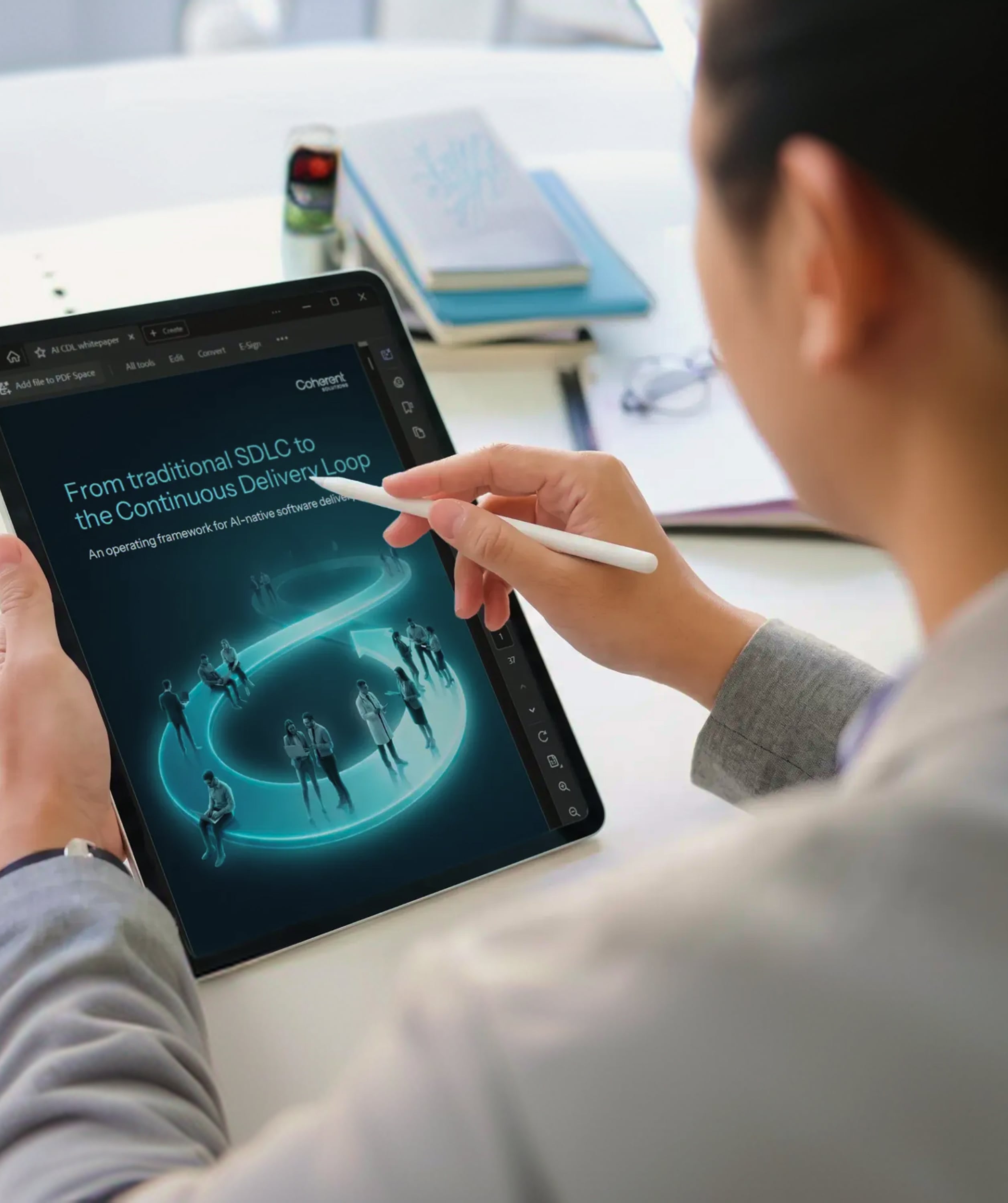
From traditional SDLC to the Continuous Delivery Loop
 Download now
We’ve done this before
We’ve worked within heavy equipment, fluid handling, battery, test-and-measurement, food, and agricultural companies.
We are not learning the manufacturing industry from a requirements document.
We’ve modernized mission-critical industrial software while it stayed in use.
We understand what an installer needs at the job site and what a dealer needs at the counter.
Leading industrial brands trust us.

"Coherent Solutions delivered a timely redesign of our app that improved UI/UX and exceeded expectations, prompting us to expand the project scope. Their expertise, attention to detail, and knowledge sharing streamlined our processes and eased internal resource constraints."
Mark A., Application Development Supervisor
Schreiber Foods
 Connect with our experts
Case Studies


Results
As a result of the fruitful and collaborative partnership between Coherent Solutions and the client, several significant outcomes were achieved, demonstrating the success and value of the collaboration. Coherent Solutions played a pivotal role in assisting the client’s digital initiatives and driving technology advancements. The key results and accomplishments include:
Development of a Stress Testing Framework: Coherent Solutions successfully developed a robust stress testing framework for the client’s services. This framework enabled the client to assess the performance and reliability of their applications under various load and stress conditions. By identifying potential bottlenecks and areas for optimization, the stress testing framework enhanced the overall quality and stability of the client’s software platform.
Integration of Usability Studies: Coherent Solutions collaborated with the client to integrate usability studies into their product. This involved conducting user research, gathering feedback, and applying best practices in user experience design. By prioritizing usability, the client was able to create intuitive and user-friendly software, resulting in enhanced customer satisfaction and improved adoption rates.
Implementation of In-Sprint Test Automation: Coherent Solutions successfully implemented in-sprint test automation for the client’s development process. By leveraging automated testing frameworks and tools, the client achieved faster and more efficient software testing, reducing manual effort and accelerating time-to-market. This automation approach ensured high product quality while optimizing resource utilization and enabling faster iterations.
Rewrite of Two Mobile Applications: Coherent Solutions undertook the task of rewriting two critical mobile applications for the client. By addressing architectural issues, improving performance, and enhancing functionality, the rewritten applications provided a superior user experience and better aligned with the client’s evolving business needs. This initiative resulted in increased customer satisfaction, improved app ratings, and a competitive edge in the market.
The combined impact of these results was far-reaching, positively influencing the client’s quality engineering department and overall operations. Coherent Solutions’ contributions not only enabled the successful transition of the client from a product company to a software platform provider but also laid a solid foundation for future growth and innovation. By addressing key challenges and leveraging technological advancements, Coherent Solutions helped the client optimize their software platform, improve customer experiences, and drive business success in the dynamic and competitive marketplace.
, hide_section_=true, module_id=223641064615}, css={}, child_css={}, id=module_179121423312165, name=module_179121423312165, type=module, order=7, label=Case Study Content Section 2, smart_type=null, styles={}, module_id=223641064615}, module_179121449478468={body={discription=, hide_section_=false, module_id=223640945533}, css={}, child_css={}, id=module_179121449478468, name=module_179121449478468, type=module, order=9, label=Case Study Content Section 3, smart_type=null, styles={}, module_id=223640945533}, module_179121507763678={body={discription=[Fully managed QA services, Flexible QA capacity on demand, Reliable release results], module_id=223640945724}, css={}, child_css={}, id=module_179121507763678, name=module_179121507763678, type=module, order=6, label=case-study-three-column-card, smart_type=null, styles={}, module_id=223640945724}, module_17921485850025={body={module_id=224578905090, quotes_description=, quotes_image={alt=, src=}}, css={}, child_css={}, id=module_17921485850025, name=module_17921485850025, type=module, order=4, label=case-study-full-width-quotes-block, smart_type=null, styles={}, module_id=224578905090}, module_179121390029660={body={discription=Solution
To meet the client’s needs and facilitate their transition to a software platform provider, Coherent Solutions devised a comprehensive solution encompassing various elements to ensure a successful partnership and support the client’s growth objectives.
Understanding the Client’s Needs and Culture: Coherent Solutions conducted a thorough analysis of the client’s requirements, organizational culture, and long-term goals. This understanding allowed us to determine the most suitable staffing model and ensure alignment throughout the collaboration.
Scalable Resource Model: Recognizing the client’s need for rapid growth, resource stability, and optimized utilization, Coherent Solutions implemented a scalable resource model. This approach allowed us to quickly ramp up the Coherent team while maintaining a low attrition rate, ensuring a consistent and reliable talent pool throughout the project’s lifecycle.
Onsite Team Manager: Coherent Solutions strategically added an onsite Team Manager, leveraging their expertise to enhance coordination and communication between different teams and stakeholders. This on-site presence helped streamline processes, resolve any issues promptly, and ensure efficient project management.
Client-Focused Onboarding and Training Program: Understanding the importance of seamless integration and knowledge transfer, Coherent Solutions established a client-focused onboarding and training program. This initiative ensured that the client’s team members were well-equipped with the necessary skills and expertise to maximize the collaboration’s effectiveness.
Onsite Scrum Master/Consultant: To enhance coordination and manage all Coherent Solutions teams effectively, an onsite Scrum Master/Consultant was assigned. This expert played a pivotal role in facilitating agile methodologies, overseeing project timelines, and optimizing team performance, resulting in increased efficiency and streamlined project execution.

More Case Studies
, hide_author_name_=false, module_id=224238135902, select_blog=224579243279, select_tag=manufacturing-industrial-services}, css={}, child_css={}, id=module_179015393630755, name=module_179015393630755, type=module, order=12, label=Related Case Study Posts, smart_type=null, styles={}, module_id=224238135902}, module_179121160763349={body={module_id=223636303144, slider_image=[]}, css={}, child_css={}, id=module_179121160763349, name=module_179121160763349, type=module, order=8, label=fullwidth-image-slider, smart_type=null, styles={}, module_id=223636303144}}

Ready to build something people use every day?
Whether you want to launch a new product, scale an existing platform, or recover legacy technical debt, let’s talk about what’s actually blocking you.