
When organizations talk about scaling software delivery, their priorities have shifted from staff augmentation to workflow improvement and co-creation. While companies can find and hire capable staff, they still struggle to deliver on time and consistently. Staff augmentation, or adding more engineers, used to solve delivery bottlenecks because capacity and throughput moved together. With the introduction of AI-native delivery systems, capacity has increased, but staff augmentation is no longer the silver bullet solution for delivery bottlenecks. Instead, companies are looking at workflow and ownership improvements that equip the delivery system to support AI, rather than just adding more team members.
At Coherent Solutions, we've seen this shift firsthand. One of our long-standing clients, a leading North American food delivery platform, began as staff augmentation engagement over six years ago. Over time, our engineers have built deep context, moving the relationship toward something closer to co-creation. Because they have a partner who understands their system, not just the ticket, the client sees faster release cycles and fewer handoff delays. Co-creation works this same way at scale: instead of adding capacity to an existing process, the engineering partner and the client share ownership of how work moves through the system, which is what makes AI-native delivery systems outperform simple staff augmentation.
How the delivery process begins to break down
In traditional delivery systems, breakdowns rarely happen overnight. New engineers join a team, but their output is inconsistent. Work is assigned, but true ownership remains unclear, and decisions get stuck at the same bottlenecks. Teams try to keep things moving by coordinating and escalating issues, but the core structure doesn't change.
Over time, these individual issues cause pressure to build, and the team's conversations and focus to shift. They begin to ask why progress isn't speeding up, rather than whether the right work is being done. That shift in focus just adds more coordination overhead on top of a process that was already struggling to keep pace.
Why adding more engineers makes the problems worse
As more people join the team, however, ownership is often divided; priorities shift without clear links to business goals, and accountability is spread thin with little alignment. In this situation, staff augmentation not only falls short, but also allows organizations to avoid fixing these issues.
When this occurs, engineers spend more time syncing and redoing work instead of delivering. Validation also slows, and decision-making gets harder as there are more dependencies. Staff augmentation alone ignores a crucial consideration; efficiency isn’t just how much work gets done, but how smoothly it moves through the system.
Adding AI to a delivery system makes this dynamic even more pronounced. With AI, teams can produce code, tests, and documentation much faster, but their coordination methods often stay the same. In these traditional systems, validation depends on centralized review; governance only occurs at checkpoints, and a small group still handles decision-making. The existing structure, however, is unable to keep up with AI’s faster pace. When this exacerbates the system’s existing issues of coordination, validation, and decision-making, companies often circle back to staff augmentation, which creates a cycle of growing inefficiency.
Then, as the teams produce more with AI and add staff, pressure continues to build. More output increases validation, coordination, and decision pressure at the same bottlenecks. This negates the impact of AI while putting more strain on the system's ability to handle change.
From staff augmentation to process-level ownership
For companies looking to harness AI’s speed while addressing common issues across their delivery systems, the right question isn't how many engineers are needed. Instead, they should be asking whether the work that matters most has a clear owner and a path to completion. Most teams can identify their highest-priority projects. Fewer can name which teams or individuals are responsible for end-to-end delivery or identify where decisions are stalling in the system.
When companies don’t have a handle on ownership, work enters the system and gets stuck, not due to lack of effort, but because ownership is fragmented or unclear. Add AI’s speed to the mix and it’s a recipe for disaster. Fixing ownership issues requires changing the system’s structure, not just adding additional staff.
For most organizations, the fix begins with changing the delivery model. Ideally, teams should be smaller, with clear responsibilities for specific outcomes instead of simply working from shared backlogs. Technical leaders should work directly with each team to help make quick decisions, provide oversight, and ensure alignment with project outcomes.
Additionally, the focus needs to shift from tracking hours and roles to driving outcomes, achieving milestones, and owning outcomes as a team. Success should be measured by whether the work delivered drives meaningful business results, demonstrates accountability, and meets or beats timelines, not simply by the volume of work completed.
The importance of ownership in digital engineering partnerships
When partnering with a digital engineering consultant, the shift to process-level ownership and workflow improvement is the foundation of strategic co-creation, and the relationship between the company and the partner is the result, not the mechanism. Plenty of partners promise shared accountability, but most still run the same linear delivery system workflows and simply add AI onto individual steps. The client is still the one absorbing delays and rework, while the partner's AI tooling just moves the bottleneck instead of removing it.
For companies to see successful changes in delivery system outcomes and their engineering partnerships, there must be structural change. Co-creation is only possible when both sides are accountable to the same delivery metrics, not to separate contract terms that let either side point to the other when something slips.
The Continuous Delivery Loop as the operating framework
When considering what structural changes are needed in the delivery system to support digital co-creation, AI adoption, and a smoother delivery process, many companies don’t know where to start.
It’s best to begin with an understanding that the goals, and the shift in ownership and accountability required to accomplish them, don't work well in a linear delivery model. Instead, the goals need a system where decisions, validation, and execution all happen together, not in separate steps, across the system.
Why? Well, when AI speeds up certain portions of the delivery lifecycle, it requires a more responsive system to handle the additional output, governance, validation, and coordination needs. In a traditional system where many processes and workflows still rely on sequential handoffs, designated checkpoints, and centralized reviews that only flow in one direction, there’s a greater risk of security issues, bottlenecks, and quality concerns. Add this to coordination problems caused by staff augmentation and a lack of clarity in responsibility and ownership, and companies are often facing significant declines in output quality and consistency, frustration with engineering partners, and drift from business outcomes and project alignment.
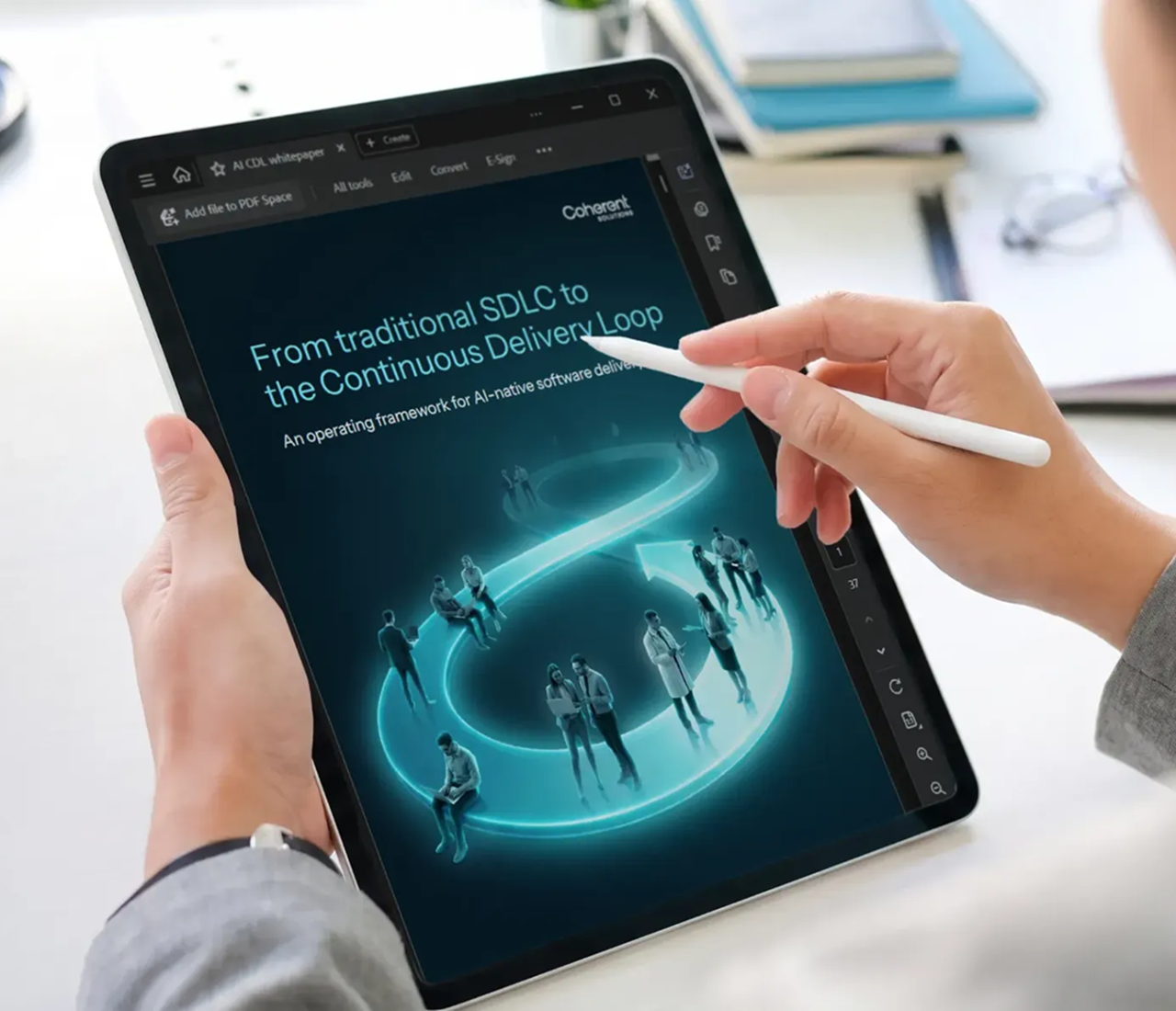
To help companies make the necessary changes in their delivery systems, Coherent created the Continuous Delivery Loop (CDL) framework. CDL solves common delivery system issues including AI adoption, team coordination, and workflow ownership. It does this by restructuring four areas where traditional delivery most commonly breaks down: how work is chosen, how it is validated, how it is built and governed, and what the team learns when it's done. Here’s how CDL shifts priorities and focus in each phase:

The result is a system where faster production driven by AI doesn't create more pressure. The CDL framework addresses coordination, validation, and accountability bottlenecks by building each of these elements into how work moves through the delivery system, instead of adding them on top.
Making structural shifts for value creation
It’s time to look beyond staff augmentation to address delivery system issues. Adding more people to a limited, linear system can lead to less impact, more delays, and lower quality over time. Changing the system, however, can improve outcomes and connect value to output. With the right structure, delivery holds up under pressure, output increases without adding staff, and accountability becomes clearer.
In the age of AI, success depends on how reliably effort leads to results. This comes from having the right structure, not just a bigger team.
SHARE ARTICLE